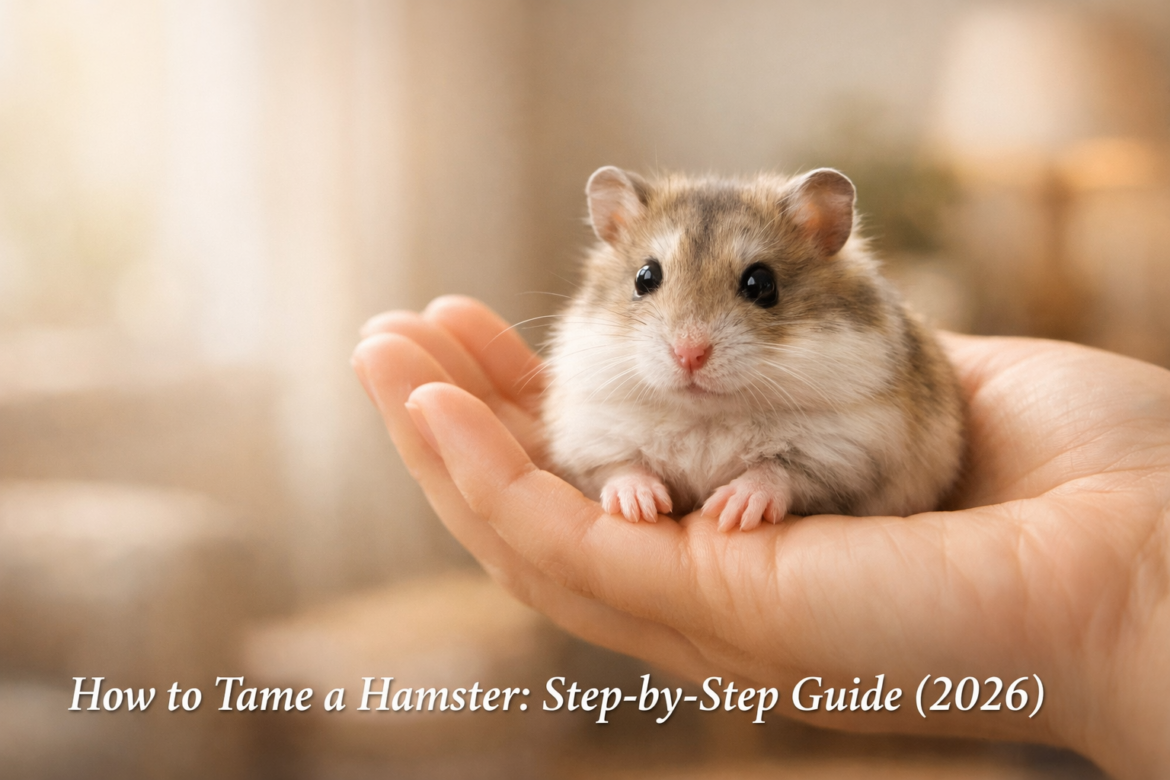
| Quick Answer: To tame a hamster, let it settle for 4-7 days first. Then slowly introduce your scent, hand-feed treats, let it climb on your hand, and gradually lift it. The whole process takes 2-4 weeks depending on your hamster’s breed and personality. Never rush — trust is everything. |
You just brought home a tiny, fluffy hamster — and now it runs away every time you come near. Sound familiar? Don’t worry. This is completely normal. Before diving in, if you are brand new to hamster ownership, we recommend reading our complete hamster care guide first — it covers everything from cage setup to feeding basics.
Hamsters are prey animals, which means their natural instinct is to be cautious around anything new — including you. The good news? With the right approach, almost every hamster can be tamed. Some take two weeks, others take two months. What matters is patience and consistency.
This step-by-step guide will walk you through everything — from the first day you bring your hamster home to the moment it happily sits on your hand. We also cover breed-specific tips, common mistakes, and what to do if your hamster bites.
Before You Start: Understanding Why Hamsters Are Nervous
Before you pick up your hamster, it helps to understand why it behaves the way it does. In the wild, hamsters are prey for owls, foxes, and snakes. This means their brain is wired to treat anything large and unfamiliar — like a human hand — as a potential threat.
When a hamster freezes, runs, or bites, it is not being difficult. It is simply following millions of years of survival instinct. Understanding this one fact changes everything:
- Your hamster is not aggressive — it is scared
- Rushing the process makes things worse, not better
- Every positive interaction builds real trust over time
- Some hamsters may always prefer minimal handling — and that is okay. Learn more about hamster behaviour and life stages to understand what to expect at each age.
Important: Hamsters also have poor eyesight. They rely on scent and sound far more than vision. This is why introducing your scent early is one of the most effective taming techniques.
How Long Does Taming Take? (By Breed)
Different hamster breeds have very different personalities. Knowing your breed sets realistic expectations. You can read our full guide to the most popular pet hamsters to understand each breed in depth before you start taming.
| Breed | Taming Difficulty | Average Time | Personality |
| Syrian (Golden) | Easy | 1-2 weeks | Friendly, calm, loves human contact |
| Teddy Bear | Easy | 1-2 weeks | Very gentle, great for beginners |
| Campbell Dwarf | Moderate | 2-4 weeks | Active and curious, can nip when scared |
| Winter White Dwarf | Moderate | 2-3 weeks | Gentle but fast — hard to catch |
| Chinese Hamster | Moderate | 2-4 weeks | Shy at first, very loyal once tamed |
| Roborovski (Robo) | Hard | 4-8 weeks+ | Extremely fast and skittish — may never sit still |
Want to know more about the Teddy Bear breed specifically? Read our detailed article: What is a Teddy Bear Hamster?
Tip for Roborovski owners: Robos are often ‘look but don’t touch’ hamsters. Instead of aiming for handling, focus on making them comfortable with your presence. That is still a success.
Step-by-Step: How to Tame a Hamster
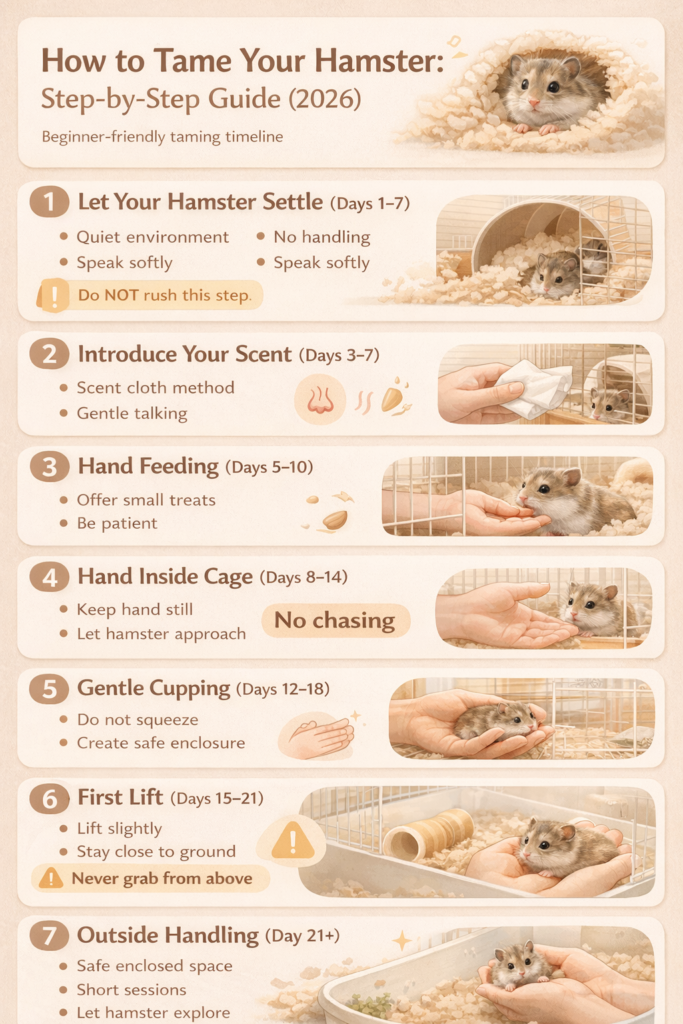
Step 1 — Let Your Hamster Settle In (Days 1-7)
This is the most important step and the one most new owners skip. When your hamster first arrives, everything is unfamiliar — the smells, the sounds, the light cycles, even the bedding. Your hamster needs time to adjust before any taming can happen.
What to do: Place the cage in a quiet room away from TVs, loud music, and other pets. Change food and water calmly without reaching in. Speak softly near the cage so your hamster gets used to your voice. Do not try to handle or reach inside.
How long: Minimum 4 days for Syrian hamsters. 5-7 days for dwarf breeds. If your hamster still seems stressed after a week, give it more time.
Signs your hamster is settling in: It eats and drinks normally when you are nearby. It explores the cage without freezing. It does not run and hide every time you walk past.
Do not be tempted to skip this step even if your hamster looks curious. Rushing now will cause mistrust that takes weeks to repair.
Step 2 — Introduce Your Scent (Days 3-7)
Hamsters navigate the world through smell. If your hand smells unfamiliar, it feels dangerous. Note that hamsters are mostly active at night — learn more about hamster sleep patterns so you can schedule taming sessions when your hamster is naturally awake and alert.
Scent cloth method: Take a small piece of clean, unscented tissue or soft cloth. Hold it in your hand for a few minutes, then place it inside the cage near the bedding. Your hamster will sniff it, investigate it, and may even use it as nesting material.
Voice familiarisation: Talk to your hamster gently every day. Your hamster just needs to learn that your voice means safety, not danger.
Step 3 — Hand Feeding Through the Cage Bars (Days 5-10)
Now it is time for your first real interaction — but on your hamster’s terms, not yours.
How to do it: Offer a small treat through the cage bars using your fingertips. Before feeding, check our hamster feeding guide to confirm which treats are safe. Good first options include sunflower seeds, a tiny piece of carrot, or cucumber. Hold the treat still and wait — do not push it towards your hamster.
What to expect: The first few times, your hamster may ignore the treat or dart away. This is normal. Keep offering daily. Within 3-5 days, most hamsters will approach your hand and take the treat from your fingers.
Why this works: Your hamster begins to associate your smell with food — one of the most powerful positive associations possible.
Always wash your hands before handling or feeding. Food smells on your hands can cause accidental nips — your hamster may mistake your finger for a snack.
Step 4 — Open Hand Inside the Cage (Days 8-14)
Once your hamster is reliably taking treats from the cage bars, it is time to move your hand inside the cage. Make sure your cage is large enough for this — your hand needs to sit flat on the floor without cramping your hamster’s space.
How to do it: Open the cage and slowly lower your flat, open hand onto the cage floor. Keep it completely still. Place a treat in the centre of your palm. Do not move. Do not chase. Just wait.
What to expect: Your hamster will cautiously sniff your hand from a distance first. Then it will approach. Then — when it is ready — it will climb on to take the treat.
Duration: Start with 5-10 minutes per session. Do this every evening when your hamster is most active. Not sure when that is? Check our hamster sleep guide for exact active hours by breed.
Step 5 — Cup Your Hand Around Your Hamster (Days 12-18)
Your hamster is now climbing on your hand for treats. Now you can begin very gently cupping your other hand around it — not lifting yet, just creating the sensation of being enclosed.
How to do it: When your hamster is sitting on your palm eating a treat, slowly bring your other hand over to form a loose cup. Do not grip. Do not squeeze. Just gently surround. If your hamster freezes or tries to leave, remove your hand immediately.
Why this matters: Hamsters feel most secure when enclosed on all sides — it mimics the safety of their burrow.
Step 6 — Gentle Lift Inside the Cage (Days 15-21)
This is the first real lift — but you are still inside the cage, close to the ground.
How to do it: With your hamster sitting comfortably in your cupped hands, slowly raise your hands 2-3 centimetres off the cage floor. Hold for a few seconds, then lower gently. Repeat daily.
Critical rule: Always scoop from below. Never grab from above — a hand descending from above mimics a bird of prey. If your hamster seems consistently stressed during this step, check whether it might be unwell — trembling or unusual behaviour can signal illness. Our guide on why hamsters shake can help you tell the difference between fear and illness.
If your hamster jumps: Stay calm, lower your hands to the cage floor, and let it settle. Never try to catch a falling hamster.
Step 7 — Handling Outside the Cage (Day 21+)
Your hamster is now comfortable being lifted. Time for the first session outside the cage.
Safe location: Always do first out-of-cage sessions in a safe, enclosed space. A dry bathtub works well for Syrian hamsters. A large cardboard box or a secure playpen also works. To keep your hamster engaged, consider adding hamster toys to the playpen so it has something to explore.
How to do it: Carry your hamster in your cupped hands to the safe area. Set it down and let it explore. Sit at ground level and let your hamster come to you. Keep sessions short — 10 to 15 minutes maximum at first.
What tame looks like: A well-tamed hamster will walk across your hands continuously rather than sitting still — this is normal and shows it feels safe enough to explore.
Gradually increase session length as your hamster gets more confident. Within a few weeks, most hamsters will actively climb into your hands when you open the cage. For ongoing physical and mental stimulation, read our hamster exercise wheel guide — a tired hamster is a calmer hamster.
Reading Your Hamster’s Body Language
Knowing when your hamster is comfortable and when it is stressed will help you avoid setting back your progress.
Signs your hamster feels safe:
- Approaching your hand willingly
- Eating calmly while on your hand
- Grooming itself while near you — grooming only happens when a hamster feels completely relaxed
- Stretching out and yawning
- Slow, relaxed movements
Signs your hamster is stressed — stop and give it space:
- Freezing in place or running and hiding — this links directly to cage bar biting, which is another sign of stress worth reading about
- Chattering teeth
- Ears flat against the head
- Puffed up fur
- Squeaking when touched — if accompanied by shaking, read our guide on why hamsters shake
What to Do If Your Hamster Bites
Being bitten is a normal part of taming a hamster. It does not mean your hamster is aggressive or untrainable. For a deeper understanding of biting behaviour, read our dedicated article: Hamster Biting: Causes, Prevention and Fixes.
If your hamster bites:
- Do not pull your hand away sharply — this can injure your hamster and teaches it that biting makes the threat disappear. Instead, stay as still as possible.
- Say a calm, firm ‘no’ — not a shout, just a clear signal.
- Gently lower your hand to the cage floor and let your hamster step off.
- Wash the bite with soap and water.
- Take a break for the day — do not try to continue the session immediately.
Why hamsters bite: Almost always fear, being startled from sleep, or smelling food on your fingers. See our full article on why hamsters bite cage bars to understand fear-based behaviour in more depth.
Never wake a sleeping hamster to handle it. A hamster woken suddenly from deep sleep will almost always bite as a reflex. Check our hamster sleep guide for active hour schedules so you always handle at the right time.
7 Common Taming Mistakes to Avoid
- Skipping the settling-in period — the most common mistake new owners make
- Trying to tame during the day when your hamster is sleeping — check hamster sleep patterns to know the right time
- Moving too fast through the steps before trust is established
- Forcing your hamster to stay on your hand when it wants to leave
- Letting children handle an untamed hamster unsupervised
- Using gloves — they block your scent and slow down the process significantly
- Stopping daily interaction once tamed — hamsters that are not handled regularly become shy again. Regular handling also helps you monitor hamster weight and spot early signs of illness.
Taming Progress Timeline at a Glance
| Days | Goal | Success Sign |
| 1-4 | Settling in — no handling | Hamster eats and explores when you are nearby |
| 5-7 | Voice and scent introduction | Hamster does not run when you speak |
| 7-10 | Hand feeding through bars | Hamster takes treat from your fingers |
| 10-14 | Open hand inside cage | Hamster climbs on your palm willingly |
| 14-18 | Cupping and gentle lift | Hamster stays calm when lifted 2-3cm |
| 18-25 | First out-of-cage session | Hamster explores calmly outside the cage |
| 25-30+ | Fully tamed | Hamster approaches your hand when cage opens |
Can You Tame an Older Hamster?
Yes — but it takes more patience. To understand how age affects hamster behaviour and temperament, read our guide on hamster life stages from baby to senior. Older hamsters that have never been handled, or that have had negative experiences with humans, need extra time to build trust.
The same steps apply, but each stage may take twice as long. Some older hamsters will reach a point where they are comfortable on your hand but will never enjoy being picked up. This is a valid outcome — respect your hamster’s limits.
If you are concerned about your older hamster’s health alongside taming challenges, our hamster diseases guide covers age-related conditions to watch for. Keeping track of hamster lifespan by breed also helps you understand what stage of life your hamster is at.
How to Tame and Handle my new hamster
Frequently Asked Questions
How long does it take to tame a hamster?
Most Syrian hamsters can be tamed within 2-4 weeks with daily sessions. Dwarf breeds typically take 3-6 weeks. Roborovski hamsters may take 8+ weeks. See the breed table above for a full comparison, or read our guide to popular hamster breeds.
My hamster runs away every time I put my hand in. What am I doing wrong?
You are likely moving too fast. Go back to Step 3 — hand feeding through the cage bars. Your hamster needs to associate your hand with positive things before it will feel safe around it. If your hamster is also biting the cage bars, read our article on why hamsters bite cage bars — the two behaviours are often linked.
Is it normal for a hamster to bite during taming?
Yes, completely normal. It means your hamster is scared, not aggressive. Follow the steps above — stay calm and go back one step in the process. For a full breakdown of biting triggers and how to fix them, see our complete hamster biting guide.
How often should I handle my hamster?
During taming, short daily sessions of 5-15 minutes are ideal. Once tamed, aim for at least 3-4 sessions per week. Hamsters that are not handled regularly can become shy again. Regular handling also lets you check for signs of common hamster diseases early.
My hamster is tame with me but bites strangers. Is this normal?
Very normal. Hamsters recognise individuals by scent and voice. To your hamster, another person is a complete stranger. Introduce new people using the same early steps — hand feeding first, then gradual contact over several days.
Final Thoughts
Taming a hamster is one of the most rewarding experiences of hamster ownership. The key principles to remember:
- Go at your hamster’s pace, not yours
- Every positive interaction is a deposit in the trust bank
- Never punish fear — it only deepens mistrust
- Consistency matters more than the length of each session
- Some hamsters will surprise you with how quickly they tame — both outcomes are completely normal
Related Guides on Innovative Posts
Now that you are taming your hamster, here are the next most useful guides to read:
- How to Take Care of a Hamster: Complete Beginner’s Guide — the full care guide that covers everything
- Hamster Biting: Causes, Prevention and Fixes — for when biting continues after taming
- Why Is My Hamster Biting the Cage Bars? — understand stress-related behaviour
- Hamster Sleep Guide: Understanding Sleep Patterns — plan your taming sessions around active hours
- Hamster Toys for Mental and Physical Stimulation — keep your tamed hamster happy and engaged
- Hamster Cage Guide: Sizes, Types and Setup — make sure your cage is set up for success
- Hamster Feeding Guide with Safe and Unsafe Foods — choose the right treats for taming sessions
- Hamster Life Stages: Baby to Senior — understand how age affects tamability
- Hamster Diseases Guide — spot health issues that can make taming harder
- Most Popular Pet Hamsters — learn about your breed’s specific personality