How to stop a hamster from biting is the most searched hamster question in 2026 — and the answer starts with one simple truth: hamsters bite out of fear, not aggression.
With consistent handling, trust-building, and a calm environment, most hamsters stop biting within 2–4 weeks. If your hamster has bitten you, you are not alone. This guide covers every cause, every fix, and everything vets recommend — so you can finally enjoy handling your hamster without fear.
For a full overview of hamster care, visit our Complete Hamster Care Guide for Beginners.
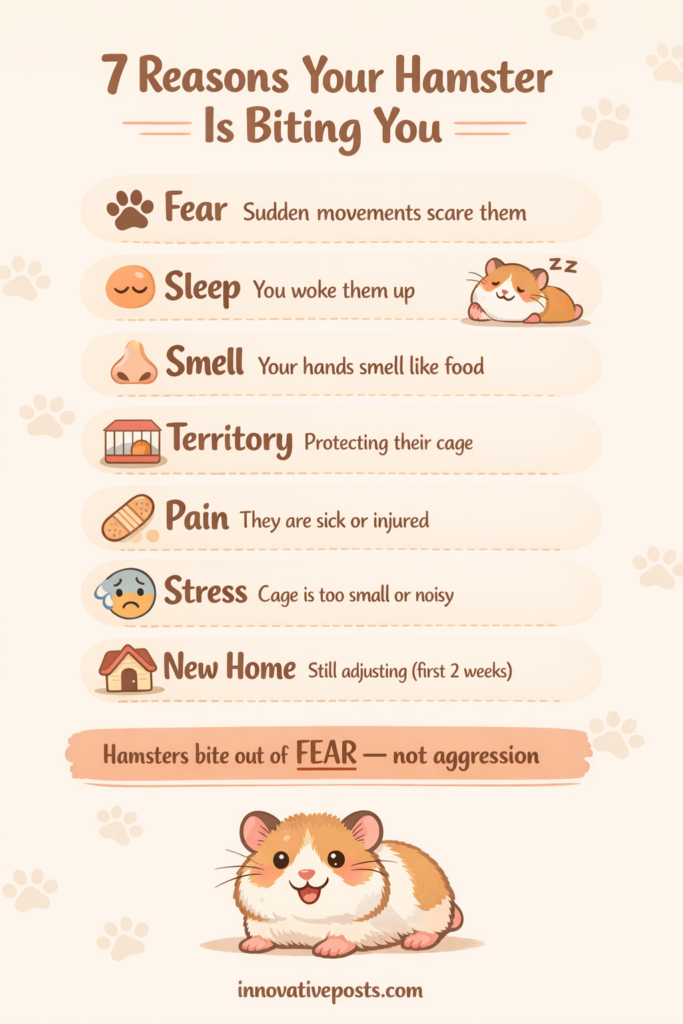
1. Why Do Hamsters Bite? (All Real Causes)
Hamsters do not bite to be mean. Every bite has a reason. Here are the most common ones:
| Cause | What It Means | Fix |
|---|---|---|
| Fear of sudden movements | Hamster feels threatened | Approach slowly, crouch down to cage level |
| Woken during sleep | Startled reflex — natural response | Only handle when hamster is active (evening/night) |
| Strong scent on hands | Mistaken for food or predator | Wash hands with unscented soap before handling |
| Territorial instinct | Protecting cage or food bowl | Never reach into cage from above; open door first |
| Rough or inconsistent handling | Hamster never learned to trust | Follow the trust-building steps below |
| Pain or illness | Dental issues, injury, or infection | Check teeth, fur, and appetite — visit vet if needed |
| New environment stress | Adjustment period (first 1–2 weeks) | Give space; limit handling for the first 7 days |
| Hunger | Hamster associates hands with food | Feed before handling sessions |
Expert Tip: Hamsters have poor eyesight. They rely heavily on smell and sound. A hand that smells like food, lotion, or another animal can easily trigger a defensive bite — even from a tame hamster.
2. How to Tell What Kind of Bite It Is
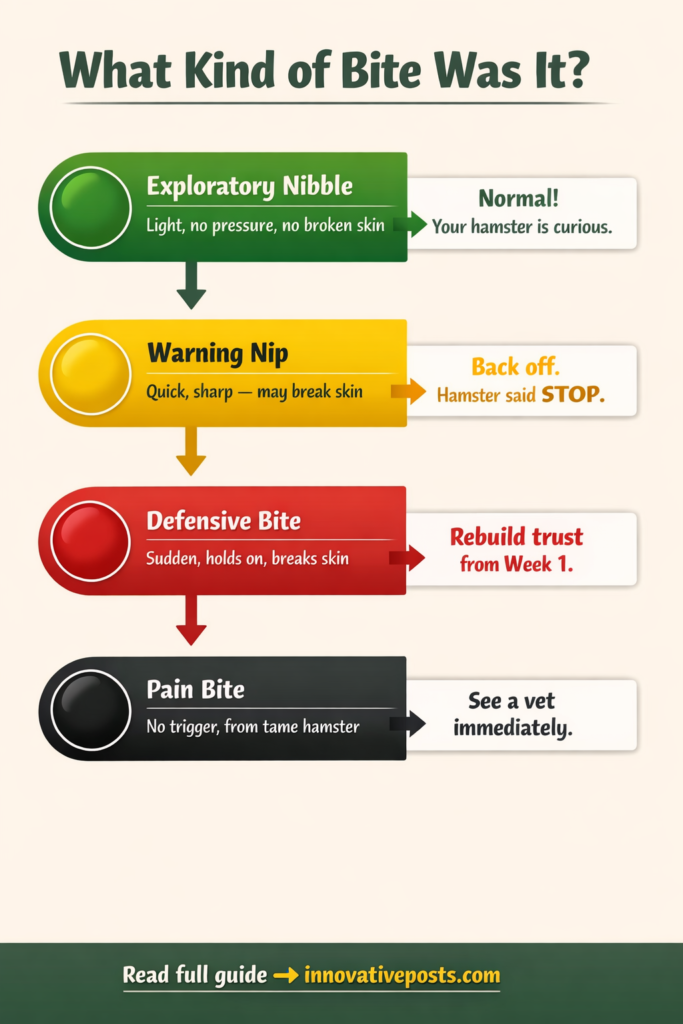
Not all bites are equal. Knowing the type helps you respond correctly.
Exploratory Nibble
- Very light, no pressure
- Hamster is curious about your scent
- Does not break skin
- Normal — not a problem
Warning Nip
- Quick, slightly sharp
- Hamster is saying “stop” or “I’m uncomfortable”
- May or may not break skin
- Signal to back off immediately
Defensive Bite
- Sudden, firm, holds on
- Hamster feels trapped or extremely scared
- Breaks skin
- Requires trust rebuilding from scratch
Pain-Related Bite
- Happens unexpectedly from a tame hamster
- No obvious trigger
- May be accompanied by lethargy, weight loss, or behavior changes
- See a vet — this is a health warning sign
According to the American Veterinary Medical Association
(AVMA), sudden behavioral changes in small pets often
indicate underlying health issues that require professional
evaluation
3. Step-by-Step: How to Stop a Hamster From Biting
This is the method that actually works — backed by hamster behaviorists and experienced owners.
Phase 1: Stop Handling (Days 1–7)
If your hamster is biting frequently, stop handling completely for one week. This sounds counterintuitive, but forcing interaction increases fear.
- Place your hand near (not inside) the cage daily
- Let the hamster sniff through the bars
- Talk softly near the cage for 5 minutes each day
- Do not make eye contact — hamsters find direct stares threatening
Phase 2: Scent Introduction (Days 7–10)
- Place a small piece of cloth with your scent inside the cage
- Offer treats through the cage bars with fingers flat (not pinched — pinched fingers look like food)
- If the hamster takes the treat without biting, that is progress
Phase 3: Hand Entry (Days 10–14)
- Open the cage door (do not reach in yet)
- Place your hand flat on the floor of the cage
- Let the hamster approach you — do not chase or grab
- If it climbs on your hand voluntarily, that is a major trust milestone
Phase 4: Short Lifts (Week 3)
- Scoop from underneath with both hands
- Lift only 2–3 inches off the cage floor at first
- Session duration: 3–5 minutes maximum
- End the session while it is still going well — before the hamster gets stressed
Phase 5: Regular Handling (Week 4 onward)
- Gradually increase time to 10–15 minutes
- Handle at the same time each day (consistency matters)
- Always end with a treat
Patience Note: Syrian hamsters often respond within 2–3 weeks. Dwarf hamsters can take 4–6 weeks. Roborovski hamsters may never fully enjoy handling — and that is okay. See our guide on How to Tame a Hamster for breed-specific taming strategies.
4. Trust-Building Timeline: What to Expect Week by Week
| Week | Expected Behavior | Your Goal |
|---|---|---|
| Week 1 | Hiding, freezing, biting if touched | No handling — scent only |
| Week 2 | Sniffing your hand, taking treats cautiously | Hand near cage, treats through bars |
| Week 3 | Climbing on hand voluntarily | Allow it to explore your hand in cage |
| Week 4 | Tolerating short lifts | Brief pick-ups, 3–5 minutes |
| Week 5–6 | Relaxed in hands, minimal biting | Regular 10–15 min sessions |
This is not a rigid schedule — every hamster is different. Some move faster, some slower. The key is to let the hamster set the pace.
5. Cage and Environment Fixes That Reduce Biting
Stress is the number one trigger for biting. A better cage setup often reduces biting dramatically — even before you change how you handle your hamster.
Checklist:
- ✅ Cage size: Minimum 40″ x 20″ floor space (bigger is always better)
- ✅ At least 2–3 hiding spots or hides
- ✅ Deep bedding: 6+ inches for burrowing
- ✅ Exercise wheel (silent spinner, 8–11 inches depending on breed)
- ✅ Cage placed away from TVs, speakers, and direct sunlight
- ✅ Temperature: 68–75°F (20–24°C) — avoid drafts
- ✅ No other pets visible or audible near the cage
- ✅ Clean cage weekly (but keep some used bedding for familiar scent)
A hamster that has enough space, enrichment, and security bites far less. Learn more in our Hamster Enrichment Guide and Hamster Cage Guide.
6. Health-Related Biting: When to See a Vet
Sometimes biting is a symptom, not a behavior problem. If your hamster suddenly starts biting after being tame, check for these signs:
Dental Problems
Hamster teeth grow continuously. Overgrown or misaligned teeth cause pain during eating and handling.
- Signs: Difficulty eating, drooling, weight loss, biting when touched near the mouth
- Fix: Vet visit for teeth trimming; provide chew toys to naturally wear down teeth
Injury or Abscess
An internal injury or abscess causes pain when touched in a specific area.
- Signs: Flinching when touched in one spot, limping, swelling
- Fix: Vet examination immediately
Skin Conditions
Mites, ringworm, or allergies cause itching and irritation — and hamsters may bite when touched on sensitive areas.
- Signs: Hair loss, scratching, redness — also see our Bald Hamster Guide
- Fix: Vet-prescribed treatment
Illness (General)
A sick hamster is a grumpy hamster. Any illness can cause increased biting.
- Signs: Lethargy, diarrhea, wet tail, runny nose
- Fix: Immediate vet visit — see our Hamster Diseases Guide and Hamster Wet Tail Guide
Rule of thumb: If a previously tame hamster starts biting suddenly with no change in handling routine, treat it as a health concern first — not a behavior problem.
7. Biting by Breed: Syrian vs Dwarf vs Roborovski
Different hamster species have different temperaments. What works for one breed may not work for another.
Syrian Hamster
- Temperament: Generally calm, bonds well with single owner
- Biting tendency: Low once tamed
- Best for: First-time owners, children (with supervision)
- Taming timeline: 2–3 weeks
- Note: Must be housed alone — will bite and fight other hamsters
Campbell’s Dwarf / Winter White
- Temperament: Active, curious, but more reactive
- Biting tendency: Medium — more likely to nip when startled
- Best for: Patient owners comfortable with quick movements
- Taming timeline: 3–5 weeks
Roborovski Hamster
- Temperament: Extremely fast, skittish, rarely enjoys handling
- Biting tendency: Low biting but high escape attempts
- Best for: Owners who prefer to observe rather than handle
- Taming timeline: May never fully tame for handling
Chinese Hamster
- Temperament: Gentle and curious, but shy
- Biting tendency: Low
- Best for: Experienced owners
- Taming timeline: 3–4 weeks
See our full breakdown: 5 Most Popular Pet Hamsters
8. Common Mistakes That Make Biting Worse
These are the most frequent errors that keep hamsters biting — even when owners are trying to help:
❌ Grabbing from above This mimics a bird of prey attack. Always scoop from below.
❌ Waking the hamster to handle it Hamsters are crepuscular/nocturnal. Handling during the day causes grumpy, defensive biting. Wait until evening.
❌ Wearing gloves Gloves mask your scent and make you feel less familiar. Hamsters trust scent — use bare, clean hands.
❌ Handling after touching food Your fingers smell like food. Wash hands thoroughly with unscented soap.
❌ Forcing interaction after a bite A bitten owner often tries to “show the hamster who’s boss.” This backfires badly. Give space after any bite.
❌ Inconsistent handling Handling daily one week, then not at all for two weeks, resets trust entirely. Consistency is everything.
❌ Multiple people handling too quickly Bond with one person first. Introduce other family members only after the hamster is consistently calm.
FAQs 2026
1. My hamster bites me every single time I pick him up. Is he just mean?
No — this is almost always a trust deficit. Your hamster has learned that hands equal something scary. Go back to Phase 1 of the trust-building process and start over. It takes patience but almost always works.
2. My hamster bit me and drew blood. What should I do?
Wash the wound thoroughly with soap and water for at least 5 minutes. Apply antiseptic. Hamster bites rarely cause serious infection, but monitor for redness or swelling over 24 hours. If you experience fever or the wound does not heal, see a doctor. Hamsters in captivity very rarely carry rabies — but any unusual bite from a wild-caught or unvaccinated animal should be evaluated by a healthcare professional.
3. Why does my hamster bite the cage bars at night?
This is usually boredom, stress, or a cage that is too small. Cage bar biting is different from people-biting. Read our dedicated guide: Why Is My Hamster Biting the Cage Bars?
4. My hamster never used to bite — why did he start suddenly?
Sudden biting in a previously tame hamster is almost always health-related. Check for dental problems, injuries, skin conditions, or general illness. Schedule a vet visit if you notice any other symptoms. See our Hamster Shaking Guide if shaking accompanies the biting.
5. Can I use gloves to handle a biting hamster?
Short answer — no. Gloves hide your scent, which is exactly what hamsters use to build trust. Use bare, freshly washed hands. If you are nervous about bites, practice with your hand flat on a surface so the hamster can approach and leave freely.
6. How long does it take to stop a hamster from biting?
Most hamsters show significant improvement in 2–4 weeks with consistent daily trust-building. Some may take 6–8 weeks. Roborovski hamsters may always prefer minimal handling.
7. Do female hamsters bite more than males?
Female Syrian hamsters can be more territorial, especially around their nest. Males are generally calmer. This difference is most noticeable in Syrians; dwarf species show less gender-based behavioral difference.
8. My hamster bites only when I put my hand inside the cage. What should I do?
This is territorial biting — your hamster is protecting their space. Never reach into the cage from above. Instead, open the cage door and let the hamster come to your hand voluntarily. This single change resolves territorial biting for most hamsters.
9. Is hamster biting dangerous for kids?
Hamster bites from healthy, captive-bred hamsters are rarely medically serious, but they hurt and can frighten young children. Always supervise children under 10 during hamster handling. Teach children to sit on the floor while holding the hamster — this prevents injury from drops. See our Hamster Life Stages Guide for age-appropriate interaction tips.
10. My hamster bites the water bottle. Is that normal?
Yes — this is usually normal chewing behavior or frustration with a slow-flow bottle. Check that the water bottle works properly and consider adding a chew toy. See our Hamster Water Bottle Guide for recommendations.
10. Final Verdict
Hamster biting is not a life sentence. It is a communication problem — and like all communication problems, it can be solved with patience, consistency, and the right approach.
The three things that matter most:
- Give your hamster time — rushing trust always backfires
- Fix the environment — a stressed hamster in a bad cage will always bite more
- Be consistent — daily 5-minute sessions beat weekly hour-long sessions every time
Most owners who follow the trust-building phases above see real improvement within 3–4 weeks. Some hamsters become genuinely affectionate. Others remain independent — and that is fine too. The goal is a hamster that does not bite out of fear, not necessarily one that loves cuddles.
Related Articles You May Find Helpful
- How to Tame a Hamster: Step-by-Step Guide
- Why Is My Hamster Biting the Cage Bars?
- Hamster Enrichment: 10 Ways to Keep Your Hamster Happy
- Hamster Diseases: What Every Pet Owner Should Know
- Hamster and Food: Feeding Guide With Safe & Unsafe Food
- Why Is My Hamster Shaking? Causes and Solutions
- Complete Hamster Care Guide for Beginners
Author: Nilofar Zubair | Innovative Posts — Smart Guidelines for Better Living & Pet Care
Last Updated: March 2026