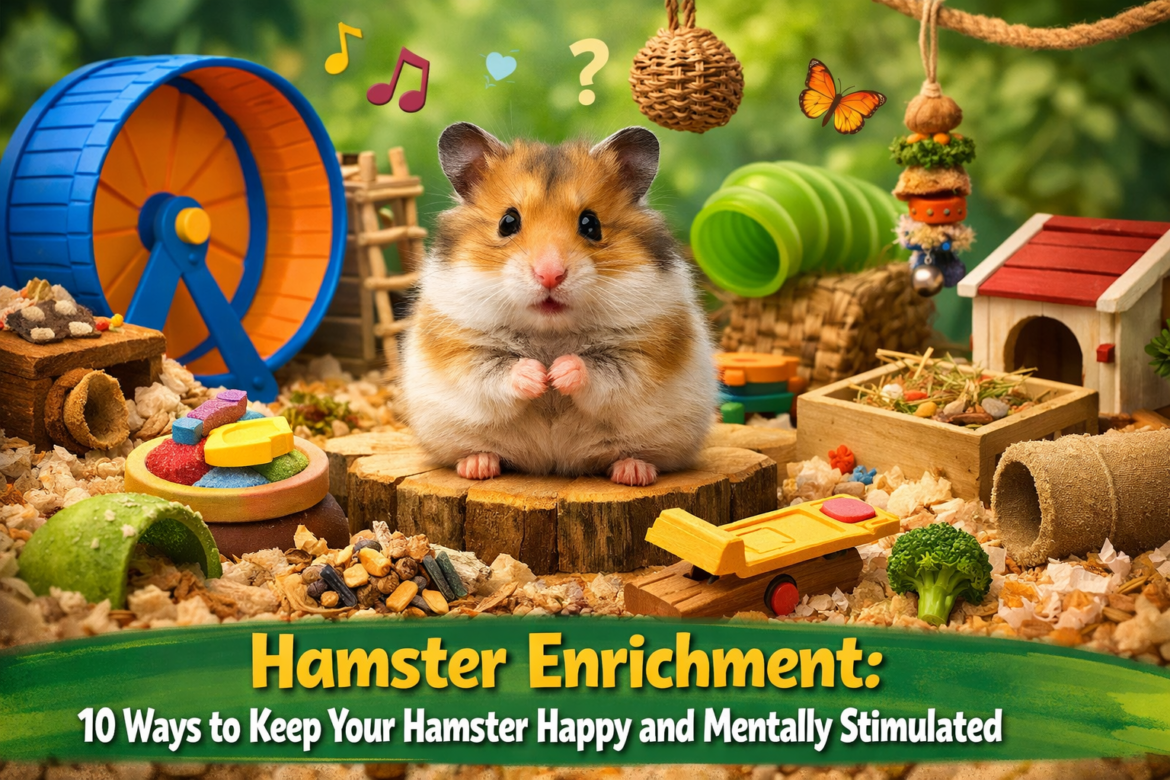
The Complete Beginner’s Guide to Hamster Mental Stimulation (2026)
If you own a hamster, you probably already know the basics. You give them food, water, a wheel, and a clean cage. But did you know that is not enough to keep your hamster truly happy? If you are new to hamster ownership, our complete hamster care guide covers everything from setup to daily routines.
Hamsters are intelligent, curious, and active animals. In the wild, they run up to 5 miles every single night. They dig tunnels, forage for food, and explore large areas. When a hamster lives in a cage with nothing to do, it gets bored — and boredom leads to stress, depression, and even health problems.
This is where hamster enrichment comes in. Enrichment simply means giving your hamster activities, objects, and experiences that keep their mind and body busy. Think of it as making your hamster’s life exciting, fun, and full of purpose.
In this guide, you will learn exactly what hamster enrichment is, why it matters, and 10 simple ways you can start enriching your hamster’s life today — even on a budget.
| Quick Summary: Hamster enrichment means giving your hamster mental and physical activities beyond basic care. It reduces stress, prevents boredom, and improves your hamster’s overall health and lifespan. Keep reading to learn 10 easy enrichment ideas you can start today. |
What Is Hamster Enrichment? (Simple Explanation)
Enrichment is any activity, toy, food, or change in the environment that encourages your hamster to behave naturally. It activates their brain, gives them a job to do, and lets them express natural instincts like digging, foraging, climbing, and exploring.
There are three main types of hamster enrichment:
- Physical enrichment — things that get your hamster moving (wheels, tunnels, climbing structures)
- Mental enrichment — things that make your hamster think (foraging, puzzles, hiding food)
- Sensory enrichment — things that stimulate their senses (new smells, textures, sounds)
Most hamster owners only focus on physical enrichment — they buy a wheel and call it a day. But mental enrichment is equally important. A hamster that only runs on a wheel but has nothing else to do is like a person who only exercises but is otherwise locked in an empty room. It is not enough.
Why Does Enrichment Matter? Signs Your Hamster Is Bored
Before we get into the enrichment ideas, it is important to understand why this matters. A bored hamster does not just sit quietly. It shows clear signs of distress that many owners mistake for normal behavior.
Common Signs of a Bored or Under-Stimulated Hamster
- Bar biting — chewing on cage bars repeatedly. This is one of the clearest signs your hamster needs more stimulation.
- Repetitive pacing — running back and forth in the same pattern
- Excessive sleeping — sleeping much more than normal. Learn about healthy hamster sleep patterns here to understand what is normal.
- Aggression and biting — reacting negatively or biting when handled
- Over-grooming — grooming so much that patches of fur are lost. If you notice bald patches, read our guide on bald hamster causes and treatment.
- Loss of appetite — not eating normally
If you notice any of these signs, your hamster is telling you it needs more stimulation. The good news? Enrichment is easy, affordable, and your hamster will love you for it.
| Did You Know? Studies on hamster welfare have shown that hamsters given enrichment opportunities live longer, healthier lives and show significantly fewer stress-related behaviors compared to hamsters in bare cages. |
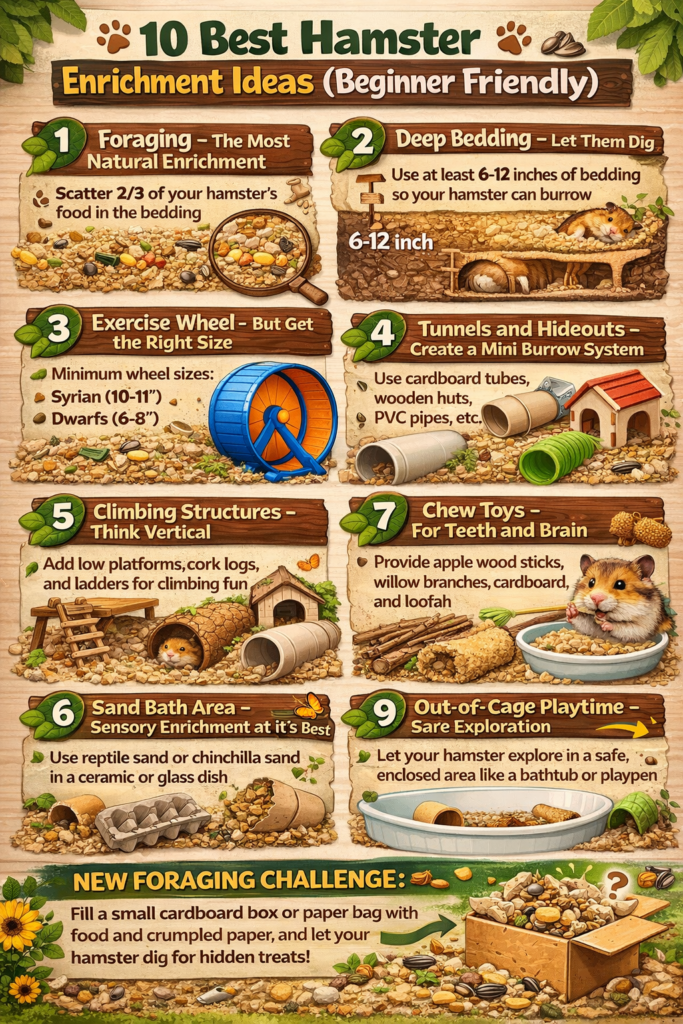
10 Best Hamster Enrichment Ideas (Beginner Friendly)
Here are 10 proven enrichment ideas that work for all hamster breeds. If you are not sure which breed you have, check out our guide on the 5 most popular pet hamsters to identify yours.
1. Foraging — The Most Natural Enrichment
In the wild, hamsters spend most of their waking hours searching for food. This is called foraging, and it is one of the most mentally stimulating activities you can give your hamster.
Instead of placing food in a bowl every night, scatter it around the cage. Hide seeds under the bedding. Tuck small pieces of vegetables in tunnels. Wrap treats in a small piece of paper for your hamster to unwrap. For a full list of safe and unsafe foods to use in foraging, see our hamster feeding guide.
This simple change transforms mealtime from a passive activity into an exciting adventure. Your hamster will spend hours exploring and digging to find every last piece of food.
How to Start Foraging Today
- Scatter 2/3 of your hamster’s daily food in the bedding instead of a bowl
- Keep one small bowl with the remaining 1/3 as a backup
- Hide extra treats like dried mealworms or a sunflower seed in different spots
- Change the hiding spots every night so it stays interesting
2. Deep Bedding — Let Them Dig
Hamsters are natural burrowers. In the wild, they dig tunnels up to 3 feet deep to sleep, store food, and hide from predators. This is a core instinct, and when you give your hamster deep bedding, you are giving them one of the most satisfying experiences possible.
Most hamster owners only put 2 to 3 inches of bedding in the cage. This is not enough. For proper enrichment, you need at least 6 inches of bedding — and ideally 10 to 12 inches for Syrian hamsters.
With deep bedding, your hamster can dig proper tunnels, create sleeping chambers, and cache food just like they would in the wild. You will notice your hamster is calmer, more content, and spends far less time biting the cage bars.
Best Bedding Types for Digging
- Paper-based bedding (like Carefresh) — soft, holds tunnels well, dust-free
- Aspen shavings — great for burrowing, natural feel
- Coconut fiber — excellent for holding tunnel shape
- Mix of two types — many owners combine paper bedding with coconut fiber for the best results
Avoid cedar and pine shavings — these contain oils that are harmful to hamsters’ respiratory systems. For a complete breakdown of every bedding type, read our hamster bedding guide.
3. Exercise Wheel — But Get the Right Size
A wheel is not just a toy — it is a necessity. But not all wheels are equal, and many hamsters suffer because their owners bought the wrong size.
A wheel that is too small forces your hamster to arch their back while running, which causes spine problems over time. This is one of the most common and easily preventable health issues in pet hamsters.
Correct Wheel Sizes by Breed
- Syrian hamsters — minimum 10 to 11 inches diameter
- Roborovski hamsters — minimum 6 to 8 inches diameter
- Campbell and Winter White — minimum 8 inches diameter
- Chinese hamsters — minimum 8 to 10 inches diameter
Always choose a solid surface wheel, not a mesh or barred one. Mesh wheels can catch your hamster’s feet and cause injuries. For detailed reviews of the best wheels and exercise balls, see our hamster treadmill and exercise wheel guide.
| Pro Tip: Place your hamster’s wheel in a corner of the cage where it feels secure. Hamsters prefer running in spots where they feel safe, not out in the open. |
4. Tunnels and Hideouts — Create a Mini Burrow System
Hamsters love feeling enclosed and hidden. It makes them feel safe. Providing a network of tunnels and hideouts in the cage mimics their natural burrow system and gives them a sense of security and adventure.
You do not need to spend a lot of money on this. Many everyday household items make excellent hamster tunnels and hides. Make sure your cage is large enough to comfortably fit tunnels alongside the wheel, food area, and sleeping space.
DIY Tunnel and Hideout Ideas
- Cardboard toilet paper rolls — free, safe, and fun to chew
- Cardboard boxes with holes cut out — make a mini maze
- PVC pipes — durable and easy to clean
- Untreated wooden huts — available at pet stores, chewable
- Clay flower pots laid on their side — great natural hides
- Coconut shells — natural, fun, and durable
Change the tunnel layout every few weeks. This gives your hamster a new environment to explore without you having to buy anything new. For hamsters, a changed cage layout is genuinely exciting.
5. Climbing Structures — Think Vertical
While hamsters are not natural climbers like mice or rats, they do enjoy low climbing structures. Adding small platforms, ramps, and cork logs to the cage adds a vertical dimension to their environment and gives them more space to explore.
Keep climbing structures low to the ground. Hamsters have poor eyesight and can fall and injure themselves from heights. Never place platforms higher than 6 inches without a safety net of deep bedding below.
Safe Climbing Options
- Cork bark logs — natural, chewable, great for exploring
- Low wooden bridges — simple ramps between two platforms
- Large smooth rocks — safe and stimulating to walk on
- Coconut husk pieces — natural texture different from the cage floor
6. Sand Bath Area — Sensory Enrichment at Its Best
A sand bath is one of the most enjoyable experiences you can give a hamster. Hamsters use sand to clean their fur in the wild — it removes excess oils and keeps their coat healthy. But beyond hygiene, a sand bath is an incredibly satisfying sensory experience for them.
Watch your hamster the first time you introduce a sand bath. They will roll in it, dig through it, and sometimes just sit in it happily. It is one of the most universally loved enrichment additions.
How to Set Up a Sand Bath
- Get a small container — a glass or ceramic bowl works perfectly
- Fill it with 2 to 3 inches of reptile sand or chinchilla sand
- Place it in a corner of the cage
- Let your hamster discover it on their own
Use only reptile sand or chinchilla dust-free sand. Never use regular playground sand or calcium-based sand — these can cause respiratory problems or digestive issues if eaten.
| Important: Never use scented sand. Hamsters have a very sensitive sense of smell and artificial fragrances can be overwhelming and stressful for them. |
7. Chew Toys — For Teeth and Brain
Hamsters’ teeth never stop growing throughout their lives. If they do not have things to chew, their teeth grow too long and cause serious eating problems. Chew toys solve this while also giving your hamster something mentally engaging to work on.
The best chew toys are made from natural, untreated wood. For a curated list of the best hamster toys for mental and physical stimulation, including top chew options, see our dedicated toys guide.
Safe Chew Materials
- Apple wood sticks — one of the most popular and widely available
- Willow branches — soft and easy to chew
- Hazelnut or birch wood
- Loofah pieces — natural vegetable sponge, great for chewing
- Pressed hay blocks — edible and chewable
- Plain cardboard — boxes, egg cartons, toilet rolls
Avoid plastic toys, painted wood, chemically treated wood, or anything with metal parts. When in doubt, choose natural and untreated.
How to Create a Safe and Stimulating Environment for Your Small Pet
8. Puzzle Feeders and DIY Enrichment Toys
Puzzle feeders are toys that hide food and require your hamster to figure out how to get it. They are one of the most powerful forms of mental enrichment because they challenge your hamster’s problem-solving skills.
You do not need to buy expensive puzzle toys. Some of the best ones are completely free to make at home.
DIY Puzzle Feeder Ideas
- Egg carton puzzle — place treats in the cups and fold the carton closed. Your hamster will rip it open to find the food.
- Cardboard roll ends — fold the ends of a toilet paper roll closed with treats inside
- Hay ball — stuff a small ball of hay with seeds hidden inside
- Paper cup — place a treat under an upside-down paper cup and let your hamster figure out how to get it
- Stacked cups — stack two or three small cups with treats between each layer
Start with easy puzzles so your hamster does not get frustrated. As they learn, gradually make the puzzles harder. Every time you introduce a new puzzle, your hamster gets a mini mental workout.
9. Out-of-Cage Playtime — Safe Exploration
Even the most enriched cage eventually becomes familiar. Giving your hamster out-of-cage playtime in a safe, enclosed space offers completely new sights, smells, and experiences that cannot be replicated inside a cage.
This is called free roam time, and it is one of the most stimulating things you can offer your hamster.
How to Set Up Safe Free Roam Time
- Choose a small, fully enclosed area — a bathtub with the drain covered works perfectly
- Add some familiar items from the cage — a hideout, some bedding, a water bottle
- Add new items to explore — a cardboard box maze, new toys, different textures
- Never leave your hamster unsupervised during free roam
- Keep sessions to 15 to 20 minutes maximum
Always do free roam time during your hamster’s active hours — usually late evening or night. To understand exactly when your hamster is naturally awake and active, read our guide on hamster sleep patterns. Never force them out during sleep hours — a disturbed hamster is a stressed hamster.
| Safety First: Make sure the area is completely hamster-proofed. Block any gaps, remove electric cables, and never let other pets into the room during free roam time. Hamsters are very fast and can disappear into tiny gaps within seconds. |
10. Rotate and Rearrange — Keep Things Fresh
One of the easiest and most underused enrichment techniques costs absolutely nothing: rearranging your hamster’s cage regularly.
Hamsters create mental maps of their environment. When everything is always in the same place, the cage becomes boring because there is nothing new to discover. But when you rearrange the layout — move the hideout, change where the wheel is, add a new piece of cardboard — your hamster suddenly has a whole new environment to explore and map.
You do not need to change everything. Even small changes make a big difference. Move two or three items to different locations during cage cleaning time. Your hamster will spend the next few hours excitedly investigating the changes.
What to Rotate or Change
- Move the hideout to a different corner
- Add new pieces of cardboard, paper, or natural materials
- Introduce a new smell — a small piece of safe herb like dried chamomile or lavender
- Change the tunnel configuration
- Add a new foraging challenge
Enrichment on a Budget — You Do Not Need to Spend Much
One of the biggest myths about hamster enrichment is that it is expensive. In reality, some of the best enrichment activities are completely free or cost almost nothing.
Free Enrichment Ideas
- Toilet paper and paper towel rolls — tunnels, chew toys, puzzle feeders
- Plain cardboard boxes — hideouts, mazes, chew material
- Egg cartons — puzzle feeders
- Scrap paper — nesting material, foraging challenges
- Rearranging the cage layout — completely free
Low-Cost Enrichment Ideas (Under $10)
- A bag of reptile sand for a sand bath
- Apple wood chew sticks — widely available and affordable
- Coconut shell hides — natural and durable
- Cork bark pieces — last for years
You truly do not need to spend a lot of money. A $0 cardboard toilet roll hidden in bedding full of seeds will make your hamster happier than a $20 plastic toy with no purpose.
Enrichment Schedule — How Often and How Much
You do not need to do everything every single day. A good enrichment schedule is sustainable and keeps things interesting without overwhelming your hamster.
Suggested Weekly Enrichment Schedule
- Every day: Scatter feed instead of bowl feeding. Check and refill water. Spot clean the cage.
- Every 2 to 3 days: Introduce a new DIY puzzle feeder or chew item. Rotate one or two cage items.
- Once a week: Full cage cleaning with a light rearrangement of layout. Refresh sand bath.
- Once a week: Supervised free roam time outside the cage.
- Once a month: Add something completely new — a new tunnel, a new hide, or a new type of natural material.
The key is variety and consistency. Your hamster should always have something new to discover, but they also need familiar elements to feel safe.
Common Enrichment Mistakes to Avoid
Even well-meaning hamster owners sometimes make enrichment mistakes. Here are the most common ones to watch out for.
Mistake 1: Overwhelming Your Hamster
Introducing too many new things at once can actually stress your hamster out. Add one new enrichment element at a time and give your hamster a day or two to adjust before adding another.
Mistake 2: Using Unsafe Materials
Not all natural materials are safe. Avoid pine and cedar wood, anything painted or varnished, plastic toys that can be chewed and swallowed, and scented or chemically treated products. If your hamster swallows something harmful, it can lead to serious illness — learn about common hamster diseases and health problems so you know the warning signs early.
Mistake 3: Disturbing Sleep Time
Hamsters are crepuscular and nocturnal — they sleep during the day. Never try to engage your hamster or do enrichment activities during their sleep hours. A hamster woken from sleep is stressed and may bite. To understand the full hamster sleep cycle, read our guide on hamster sleep patterns. Always interact during their natural active hours in the evening.
Mistake 4: Cleaning Too Thoroughly
Many owners completely clean and disinfect the entire cage every week. This removes all of your hamster’s scent markings and causes significant stress. Always leave a small amount of used bedding when cleaning. For a complete cage setup and cleaning guide, see our hamster cage guide.
FAQs About Hamster Enrichment
1. How do I know if my hamster is enjoying the enrichment?
A happy, stimulated hamster will actively explore their environment, forage enthusiastically, sleep soundly during the day, and not show repetitive behaviors like bar biting or pacing. They will also be calmer when handled and more curious about new objects you introduce.
2. Can I use hamster balls for enrichment?
Hamster balls are controversial in the pet care community. While they allow your hamster to roam outside the cage, they prevent your hamster from stopping when tired, eliminate sensory input like smells, and can cause stress. Free roaming in a safe enclosed space is a much better option. For safe exercise alternatives, check our hamster treadmill and exercise wheel guide.
3. How long should enrichment sessions be?
There is no set time limit for in-cage enrichment — your hamster can use tunnels, forage, and explore whenever they want. For out-of-cage playtime, 15 to 20 minutes is ideal. Never extend sessions if your hamster is showing signs of stress or trying to return to the cage.
4. Is enrichment important for all hamster breeds?
Yes, absolutely. All hamster species — whether Syrian, Roborovski, Campbell, Winter White, or Chinese — need mental and physical enrichment. Smaller breeds like Roborovskis are extremely fast and active and benefit enormously from enrichment. Not sure which breed you have? Our guide on the 5 most popular pet hamsters will help you identify yours.
5. My hamster ignores new toys. What should I do?
Do not worry — this is completely normal. Hamsters are naturally cautious about new objects. Leave the toy in the cage without forcing interaction. Your hamster will investigate it on their own terms, usually within 24 to 48 hours. Rubbing the toy on used bedding to add familiar scent can help speed up acceptance.
6. How does enrichment affect my hamster’s lifespan?
Enrichment has a direct positive impact on hamster health and longevity. Stress is one of the biggest factors that shortens a hamster’s life. To understand what affects your hamster’s lifespan and how to maximize it, read our hamster average lifespan guide.
Final Thoughts
Hamster enrichment is not a luxury — it is a core part of responsible hamster ownership. When you enrich your hamster’s environment, you are giving them a life that matches what nature designed them for: exploring, digging, foraging, and solving problems. If you are just starting out, our complete hamster care guide for beginners covers all the essential care basics alongside enrichment.
The great news is that enrichment does not have to be complicated or expensive. A cardboard box, some scattered seeds, deep bedding, and a regular rearrangement of the cage can transform your hamster’s quality of life completely.
Start with just one or two ideas from this guide. Watch how your hamster responds. You will quickly see the difference — more activity, less bar biting, a calmer and happier hamster.
And remember: a stimulated hamster is a happy hamster. And a happy hamster makes for a much more rewarding pet experience for you too.
innovativeposts.com — Smart Guidelines for Better Living & Pet Care