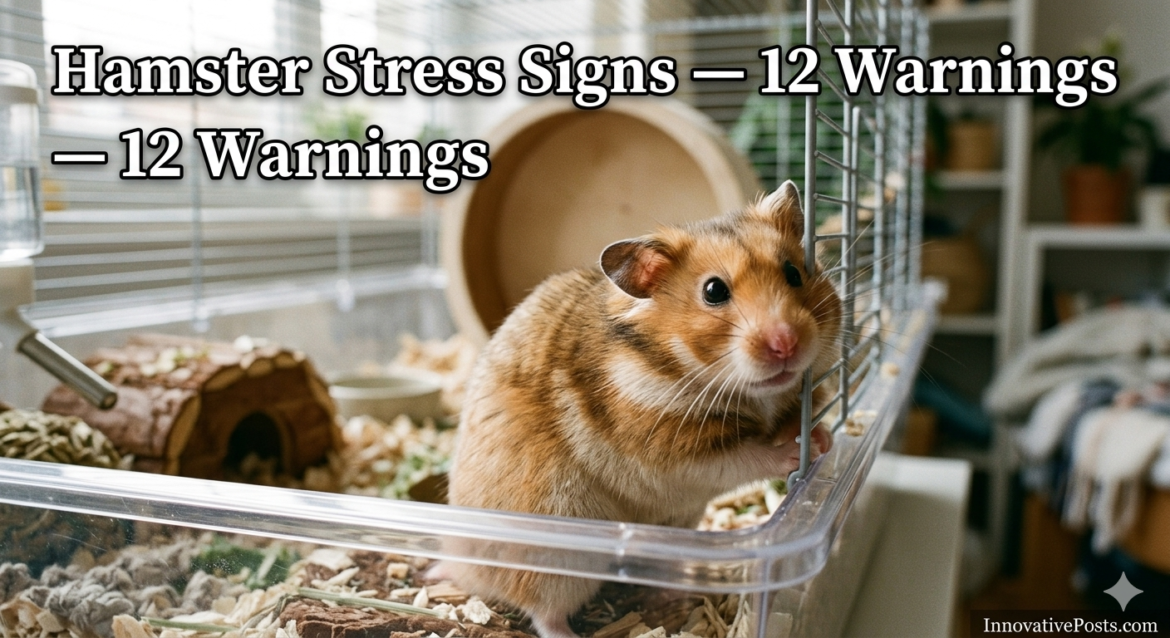
Let’s start with what most guides miss entirely: the science of why hamsters are so uniquely vulnerable to stress.
🧬 Why Hamsters Are Wired for Stress
Understanding why your hamster stresses so easily is the first step to preventing it. Hamsters are not just small dogs or cats. Their biology and psychology are fundamentally different from larger pets — and those differences make them acutely sensitive to their environment in ways that most owners never fully appreciate.
In the wild, the Syrian hamster lives as a solitary, largely nocturnal prey animal in the arid regions of Syria and Turkey. Every aspect of its biology is shaped by one overriding priority: survive long enough to reproduce. This means staying constantly alert, hiding all signs of weakness, and treating anything unfamiliar as a potential threat until proven otherwise.
A 2025 study published in the Journal of Neuroendocrinology confirmed that chronic social stress in Golden hamsters causes measurable changes in hypothalamic gene expression — altering brain chemistry, increasing aggression, and elevating long-term cortisol levels. In captive hamsters, the stressors are different from the wild but the biological response is identical.
- Cortisol is the primary stress hormone in Syrian hamsters — the same hormone that causes the human “fight or flight” response
- Research shows that even brief handling stress causes cortisol to spike by approximately 50ng/ml above baseline in dwarf hamsters
- Chronic elevated cortisol suppresses immune function, disrupts gut flora, causes weight changes, and accelerates organ aging
- Hamsters that experience repeated daily stress show lasting behavioural changes — increased aggression, impaired impulse control, and higher food intake — even after the stressor is removed
This is why addressing stress is not about making your hamster “more comfortable.” It is about preventing genuine, measurable physical harm. A chronically stressed hamster will get sick more often, recover more slowly, and live a shorter life than one kept in a consistently calm and enriched environment.
😊 vs 😰 Happy Hamster vs Stressed Hamster — Side by Side
Before we break down individual stress signs, it helps to understand what a genuinely happy, settled hamster looks like in contrast. According to exotic vet Dr. Hannah Godfrey, a settled hamster is “bright, curious, and will spend time exploring, exercising, and digging.” Knowing the baseline makes deviations immediately obvious.
✅ Signs of a Happy, Calm Hamster
- Stretches and yawns when waking up
- Grooming themselves regularly and thoroughly
- Actively foraging and exploring the cage
- Using the wheel at a relaxed, steady pace
- Stuffing cheeks and hoarding food calmly
- Building and rearranging their nest
- Bright, round, clear eyes
- Full, smooth, clean coat
- Approaches your hand with curiosity
- Eating and drinking normally
- Normal, regular bowel movements
- Relaxed body posture — no hunching
❌ Signs of a Stressed, Unhappy Hamster
- Repetitive pacing or circling
- Biting or chewing cage bars
- Hiding constantly, even during active hours
- Over-grooming or pulling out own fur
- Frantic, non-stop wheel running
- Teeth chattering or hissing
- Sudden aggression or biting
- Ears flattened back against head
- Loss of appetite or excess hoarding
- Dull, greasy, or thinning coat
- Diarrhea or soft stools
- Hunched, tense body posture
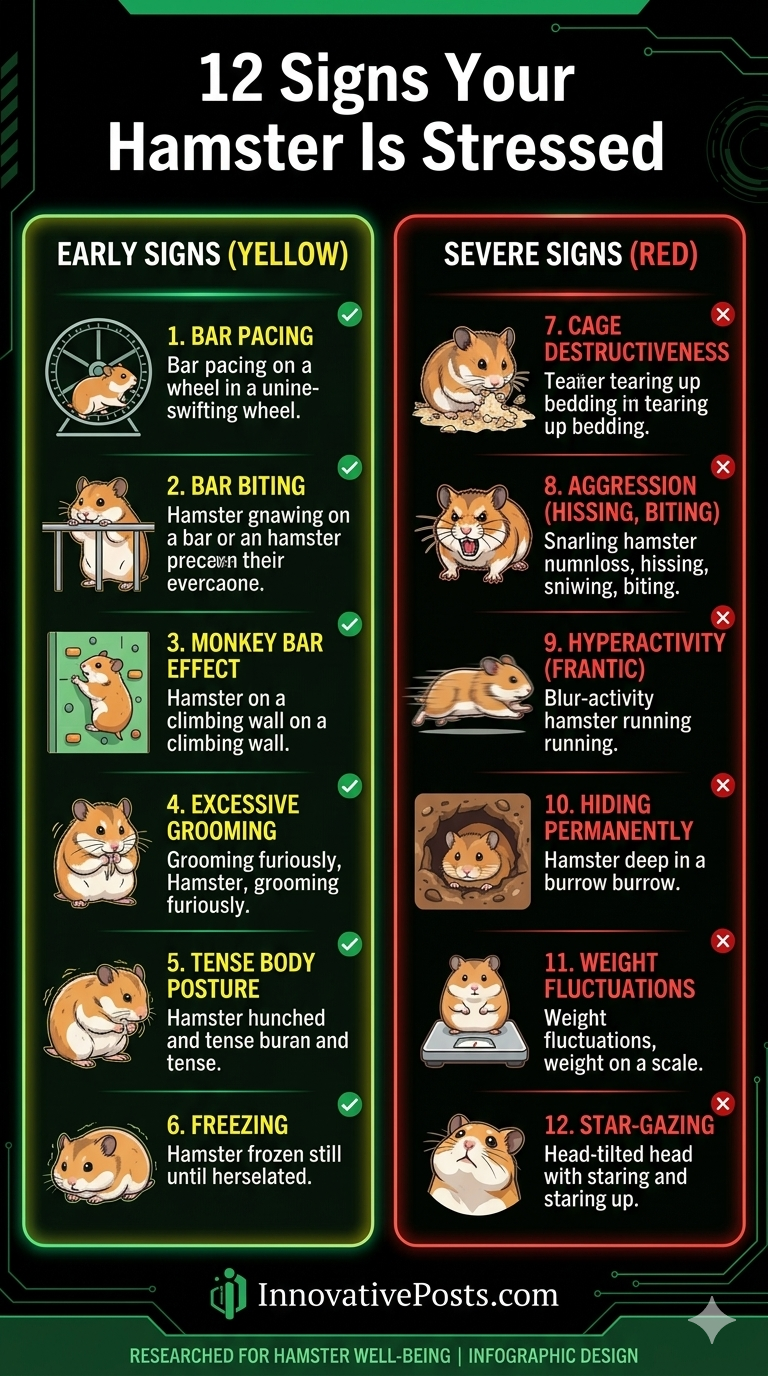
🚨 12 Signs Your Hamster Is Stressed — From Early to Severe
These signs are organised from the earliest (easiest to miss) to the most severe (requires immediate action). The earlier you catch stress, the faster and more completely your hamster can recover.
🔲 Bar Chewing & Cage Biting
Bar chewing is one of the most common — and most misunderstood — stress signs in captive hamsters. Many owners assume it is a personality quirk or a bid for attention. It is neither. Bar chewing is a stereotypy — a repetitive, compulsive behaviour that develops when an animal’s environment fails to meet its basic psychological needs.
The most common trigger is a cage that is too small. When a hamster does not have enough floor space to express natural behaviours like foraging, burrowing, and territory patrolling, it develops stereotypic escape attempts — and bar chewing is the most visible one. It can also be caused by insufficient bedding depth, no enrichment, or chronic boredom. Beyond the stress signal itself, persistent bar chewing causes tooth misalignment that makes eating progressively more painful. See our full guide: Why Is My Hamster Biting the Cage Bars?
🐒 Monkey Barring (Climbing the Cage Lid)
Hamsters are ground-dwelling animals. They do not have tails to help them balance and are not designed for climbing. When a hamster repeatedly climbs the ceiling bars of their cage — often hanging upside down — it is not amusing acrobatics. It is an active escape attempt driven by a cage that is too small, too boring, or too restrictive.
Monkey barring is physically dangerous — hamsters can fall and injure themselves — and psychologically damaging as a sign of chronic environmental stress. The immediate solution is almost always the same as for bar chewing: a significantly larger enclosure with deep bedding and proper enrichment.
🔄 Repetitive Pacing or Circling
A hamster that repeatedly runs the same short path — back and forth along one wall, or in tight circles — is displaying a classic stereotypy. This is not normal activity. Normal hamster movement involves investigation, foraging, and exploration of different areas. Repetitive pacing means your hamster’s environment is so unstimulating that it has literally run out of things to do.
This behaviour can become deeply ingrained over time and may persist even after the environment is improved. The longer it is left unaddressed, the harder it becomes to resolve. Act immediately upon noticing it.
😤 Sudden Aggression or Biting
A hamster that was previously calm but now bites, hisses, or lunges when approached is not “going bad.” It is communicating, in the clearest language available to it, that something in its life is causing significant distress. Common triggers include being woken during the day for handling, a cage placed near a predator animal (cat or dog), recent environment changes, or underlying pain from illness or dental problems.
Important: Never punish aggression in a hamster. It is always a symptom of something wrong in the environment — not a character flaw. Address the cause, not the behaviour. For detailed guidance on biting, see our Hamster Biting Guide.
👂 Ears Flattened or Pinned Back
This is one of the clearest acute stress signals in hamster body language. When a hamster pins its ears flat and back against its head, it is in an active fear or threat response. This posture often precedes a bite and means the hamster feels cornered, threatened, or overwhelmed. A hamster showing flat ears during handling needs to be placed back in the cage immediately and given time to calm down.
Normal, relaxed ears sit upright and slightly forward. Any time you approach your hamster and see the ears go flat, stop the interaction entirely and reassess what might be causing the fear response. For a complete body language reference, see our Hamster Body Language Guide.
🎡 Frantic, Non-Stop Wheel Running
Wheel running is healthy and normal — wild hamsters run up to 8 miles per night. However, there is a meaningful difference between content wheel running and frantic wheel running. A stressed hamster may run obsessively on the wheel for hours, unable to settle, as a displacement activity for unexpressed natural behaviours.
If your hamster runs on the wheel but never investigates the rest of the cage, never digs, never forages, and never settles into calm behaviours — the wheel has become a coping mechanism for a barren environment. A properly enriched cage should show a hamster that uses the wheel as one of many activities, not as its only outlet. Ensure the wheel is also the correct size — a too-small wheel adds physical stress on top of psychological stress.
🛏️ Hiding Constantly — Even During Active Hours
Some hiding is completely normal — hamsters are prey animals and naturally spend time in enclosed spaces. The concern is when a hamster hides throughout its entire active period (dusk and evening), refuses to come out even for food, and stops engaging with its environment entirely. This is a sign of severe anxiety or, in some cases, the beginning of illness.
This behaviour is commonly triggered by the presence of a cat, dog, or other pet near the cage — even if there is no direct contact. The hamster can smell and hear the predator, and its stress response keeps it locked in the hide as a survival mechanism. Other triggers include being placed in a high-traffic, noisy room. If your hamster is also not eating, this combination requires urgent attention.
🪮 Over-Grooming or Fur Pulling
Some self-grooming is healthy and normal. Over-grooming — when a hamster grooms the same area repeatedly until bald patches appear, or physically pulls out its own fur — is a serious stress indicator. It is the hamster equivalent of a human stress-picking behaviour, and it indicates that stress levels have reached a point where the animal is self-soothing through a compulsive physical action.
Note that not all fur loss is stress-related. Mites, ringworm, nutritional deficiencies, and hormonal conditions can all cause similar bald patches. A proper diagnosis is important. Read our complete Hamster Losing Hair Guide to identify the specific cause.
🍽️ Loss of Appetite or Obsessive Hoarding
Both extremes of food behaviour can signal stress. A hamster that stops eating entirely may be too anxious to come out for food — or may be experiencing physical illness triggered by chronic stress suppressing immune function. A hamster that obsessively over-hoards — filling its cheeks constantly and moving food in a frantic, repetitive pattern without stopping — may be in a state of heightened anxiety, interpreting its environment as unpredictable and dangerous.
Normal hoarding involves a hamster calmly collecting food and bringing it back to a nest storage area. Obsessive hoarding is characterised by frantic repetition, restlessness, and inability to settle even after extensive food collection. For appetite-related issues, see Hamster Not Eating: 10 Causes & What to Do.
💩 Diarrhea or Digestive Changes
The gut-brain connection is well established in mammals — and hamsters are no exception. Chronic stress disrupts the balance of gut flora, weakening the digestive system and making a hamster more susceptible to gastrointestinal infections. Loose stools, soft droppings, or changes in faecal consistency that are not linked to a dietary change are a signal that the stress response has progressed beyond purely behavioural symptoms into physical illness.
Critical warning: Loose stools combined with a wet tail area is potentially wet tail disease — a rapidly fatal bacterial infection that is closely linked to severe stress events. Do not wait if you see this combination. See our Hamster Wet Tail Guide immediately.
🔊 Unusual Vocalisations — Squeaking, Hissing, Teeth Chattering
Hamsters are generally very quiet animals. When they start making noise, something is very wrong. Squeaking during handling means acute fear or pain. Hissing is a direct defensive warning — stop the interaction immediately. Teeth chattering indicates extreme agitation, pain, or fear and often precedes a bite. These are not just vocal quirks — they are emergency signals from an animal that has exhausted its subtler communication methods.
If your hamster is regularly vocalising during normal interactions, it has moved beyond baseline stress into acute distress. A vet visit is necessary to rule out pain-related causes alongside addressing environmental triggers.
🩹 Self-Mutilation — Biting Own Paws or Flanks
This is the most severe stress sign on this list and indicates that stress levels have reached a critical, chronic state. A hamster biting its own paws, flanks, or tail is in severe psychological distress — the self-directed aggression is a last resort coping mechanism when the environment has provided no relief from chronic stress over an extended period. This requires immediate veterinary attention alongside a complete overhaul of the hamster’s living conditions. Do not attempt to manage this at home without professional guidance.
⚠️ 10 Most Common Causes of Hamster Stress
Understanding the cause is the only way to fix the problem permanently. Here are the ten root causes responsible for the vast majority of hamster stress cases:
Cage Too Small
The single most common cause. A hamster in an undersized cage cannot express natural behaviours — the resulting frustration directly manifests as bar chewing, pacing, and aggression. Minimum: 450 sq inches for dwarfs, 600+ sq inches for Syrians.
Shallow Bedding
Burrowing is a psychological need, not a preference. Less than 6 inches of bedding blocks this instinct entirely, causing chronic frustration and restlessness regardless of cage size.
Noise & Vibration
Hamsters hear frequencies humans cannot. Televisions, speakers, washing machines, and even refrigerator hum can cause low-level constant stress. Place cages in genuinely quiet rooms away from appliances.
Daytime Handling
Waking a sleeping hamster to handle it triggers an immediate cortisol spike — the same as someone shaking you awake at 3am. Do this repeatedly and you create a chronically stressed, defensive hamster.
Other Pets Nearby
A cat sitting near a hamster cage causes constant predator-stress even with no physical contact. The hamster can smell and hear the cat — and its survival brain never fully relaxes in its presence.
Over-Cleaning
Removing all scent markers from a cage in one clean is severely disorienting. Your hamster built a mental map using smell — wiping it away all at once is like waking up in a completely different house.
Frequent Environment Changes
Repeatedly moving the cage location, rearranging accessories, or changing cage type forces your hamster to constantly re-map its territory — a mentally exhausting process that never allows for settled comfort.
Poor Diet
A seed-only diet causes nutritional deficiencies that affect brain chemistry and stress tolerance. Low protein intake in particular is associated with increased anxiety behaviours in small rodents.
Wrong Wheel Size
A too-small wheel causes physical discomfort with every revolution — spinal arch, joint strain, and repetitive impact. A hamster in physical pain from poor equipment is simultaneously physically and psychologically stressed.
Underlying Illness or Pain
Pain is a stress trigger just as much as environmental factors. A hamster with dental disease, parasites, or internal illness will show all the same stress behaviours as one in a bad environment. If environmental fixes don’t improve things — see a vet.
📊 Stress Severity — What Level Is Your Hamster At?
Not all stress is equal, and the urgency of your response should match the severity. Use this framework to assess your hamster’s current stress level:
Mild Occasional bar chewing, slightly more hiding than usual, mild food hoarding increase Review cage size, bedding depth, and noise levels. Make improvements within 1 week.
Moderate Regular bar chewing, flattened ears, aggression during handling, frantic wheel use, hiding during active hours Immediate environment overhaul — larger cage, deeper bedding, enrichment. Adjust handling schedule. Monitor daily.
Severe Self-grooming to baldness, vocal distress, diarrhea, complete appetite loss, self-mutilation Vet appointment required. Complete cage redesign. Remove all stress triggers immediately.
Crisis Wet tail symptoms, self-biting, extreme lethargy, unable to move, bleeding Emergency vet visit — same day. This is a life-threatening situation requiring immediate professional intervention.
👁️ Body Language Quick Reference Guide
Your hamster’s body constantly broadcasts its emotional state. Learning to read these signals in real time changes everything about how you interact with your pet.
😌 CALM & CONTENT
- 🐾 Ears upright, slightly forward
- 👀 Bright, round, open eyes
- 🤸 Stretching and yawning on waking
- 🪮 Regular, thorough self-grooming
- 🏃 Relaxed, exploratory movement
- 🛏️ Settled nest-building behaviour
⚠️ ALERT / UNCERTAIN
- 👂 Ears partially back or twitching rapidly
- 🫥 Freezing in place — assessing threat
- 👃 Nose rapidly sniffing the air
- 🙈 Moving slowly toward cover
- 💨 Short, quick movements between stops
- 🫸 Rearing up on hind legs to look around
😨 FEAR / STRESSED
- 👂 Ears completely flat against head
- 😬 Teeth exposed — defensive display
- 🤬 Hissing or chattering teeth
- 😤 Puffing up body to appear larger
- 🏃 Frantic, erratic running
- 🩸 Biting if cornered or touched
🛠️ How to Reduce Your Hamster’s Stress: Complete Action Plan
Identifying stress is only half the job. Here is the complete, prioritised action plan for reducing hamster stress — ordered from most impactful to least:
- 1Upgrade the cage first. If your hamster is in a cage smaller than 450 square inches of unbroken floor space, no other intervention will meaningfully resolve chronic stress. Cage size is the single most impactful change you can make. A bin cage or large glass tank costs far less than repeated vet bills from stress-related illness.
- 2Deepen the bedding to at least 6 inches. The ability to burrow is a psychological need. Even in a large cage, shallow bedding blocks this instinct entirely. Increase to 6–10 inches of burrowing-capable substrate immediately if you have not done so already.
- 3Move the cage to the quietest room available. Away from the television, away from other pets, away from high-traffic hallways. Hamsters are active from dusk — they need genuine quiet and darkness during the day to sleep properly. Disrupted sleep = chronically elevated stress hormones.
- 4Stop all daytime handling immediately. Switch 100% to evening handling (7–9pm). Even well-intentioned daytime handling is a cortisol spike every single time it happens. Let your hamster set the schedule — if it is not naturally awake, do not disturb it.
- 5Add enrichment — especially scatter feeding. Switch from bowl feeding to scatter feeding immediately. This activates foraging instincts and can reduce stereotypic behaviours within days. Add cork logs, tunnels, and dried herbs for additional scent and texture enrichment. See our Hamster Enrichment Guide.
- 6Stop over-cleaning. Spot clean daily but leave the nest area and core scent markers undisturbed. Full cage cleans: maximum once every 4–6 weeks, always leaving old nesting material behind. See our Cage Cleaning Guide for the correct method.
- 7Add a sand bath if not already present. Sand bathing is self-soothing behaviour for hamsters. Access to a sand bath has been shown to reduce stress-related behaviours. See our Hamster Sand Bath Guide for full setup instructions.
- 8Keep other pets completely away from the cage area. If a cat or dog regularly approaches the cage, your hamster is in a constant state of predator-stress. Physical separation — a different room if possible — is the only effective solution.
- 9Check the diet. A seed-only diet contributes to nutritional stress. Switch to high-quality pellets with at least 16% protein. Read our Hamster Feeding Guide for complete dietary recommendations.
- 10See an exotic vet if no improvement in 2 weeks. If you have made all the above changes and stress signs persist, underlying illness or pain may be the root cause. A vet who specialises in exotic or small animals can rule out dental disease, parasites, hormonal conditions, or organ problems that manifest as stress-like behaviour.
Stereotypic behaviours like bar chewing and pacing can persist for weeks even after the environment has been improved. The brain pathways that drive these compulsive behaviours take time to weaken. Do not give up on environmental improvements if they do not produce instant results — give your hamster at least 3–4 weeks of consistent improved conditions before reassessing.
📋 Daily Stress Monitoring Checklist
Building a quick daily observation habit catches stress early, when it is easiest to address. This checklist takes under 2 minutes each evening:
- Check eyes — bright and round (good) or dull and half-closed (concern)
- Check coat — smooth and clean (good) or greasy, patchy, unkempt (concern)
- Observe first 10 minutes of activity — calm exploration (good) or frantic pacing/bar chewing (concern)
- Check food bowl or scatter area — hoarding normally (good) or completely untouched/obsessive (concern)
- Observe body posture — relaxed and upright (good) or hunched and tense (concern)
- Listen for vocalisations — silent or occasional soft sound (good) or squeaking, hissing, teeth chattering (concern)
- Check droppings — firm and regular (good) or soft, wet, or absent (concern)
- Note wheel use — one of several activities (good) or the only activity for the entire session (concern)
❓ Frequently Asked Questions (2026)
Final Thoughts: Your Hamster Is Telling You — Are You Listening?
Hamsters cannot speak. They cannot tell you they are scared, in pain, bored, or overwhelmed. But every sign in this guide — from the first subtle bar chew to the most severe self-injurious behaviour — is your hamster communicating as clearly as it possibly can through the only language it has: behaviour.
The good news is that most hamster stress is entirely preventable and reversible with the right environment. A cage that is large enough, bedding that is deep enough, a schedule that respects their sleep cycle, and an enriched space that meets their natural needs. These are not luxuries — they are the baseline every hamster deserves.
Start with the checklist in Section 7. Make changes this week. And observe your hamster every evening — because the earlier you catch a sign of stress, the easier it is to fix, and the better and longer life your hamster will live as a result.
Written by Emily Carter | Updated: April 2026 | InnovativePosts.com