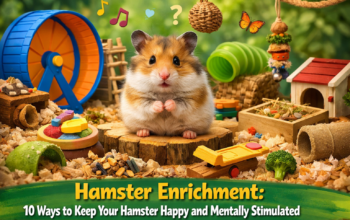
What Your Hamster Actually Does in the Wild
Before we talk about mistakes, you need to understand what a hamster is biologically designed to do. In the Syrian desert and Central Asian steppes, wild hamsters live a life that would surprise most pet owners.
🌍 Wild Hamster Facts That Change Everything
Wild hamsters run 5–8 miles every single night searching for food. A small cage with just a wheel cannot replicate this — but understanding the need changes how you design your hamster’s home.
They build burrow systems up to 3 feet deep with separate chambers for sleeping, food storage, and waste. In a cage with 2 inches of bedding, this instinct is completely blocked — causing chronic stress.
Hamsters have up to 1,000× better smell than humans. Their world is experienced almost entirely through scent. A “clean” cage may be a sensory void to your hamster.
Foraging occupies most of a wild hamster’s waking hours. A bowl of food in the corner eliminates all mental engagement from eating — the equivalent of placing every meal in a pile on the floor for a human.
Hamsters are crepuscular, not fully nocturnal — most active at dawn and dusk. Handling during midday sleep disrupts their natural rhythm and contributes to chronic stress.
11 Enrichment Mistakes You’re Probably Making Right Now
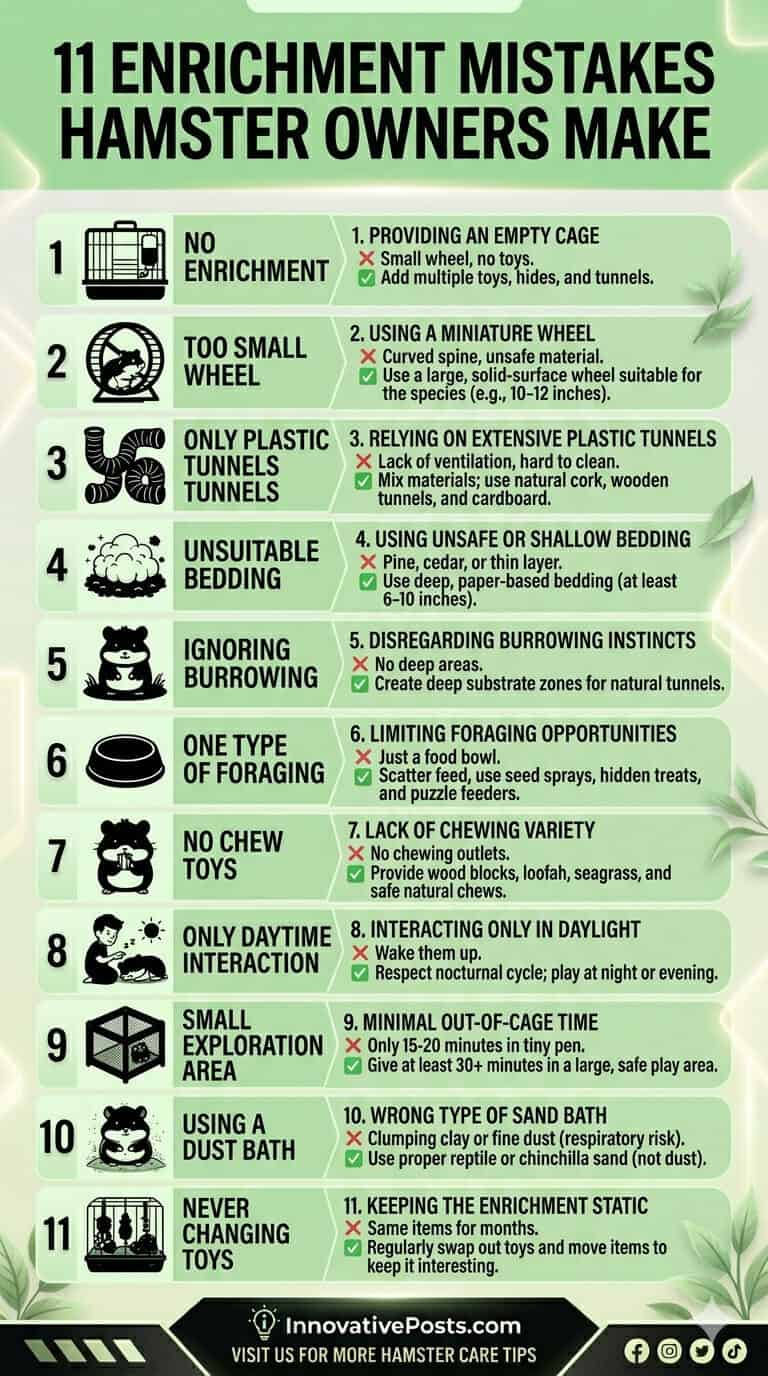
These are not the obvious mistakes like “use cedar bedding.” These are the subtle, widespread mistakes that even experienced owners make — the ones that silently reduce your hamster’s quality of life every single day.
🍽️ You Bowl-Feed Instead of Scatter-Feed
A food bowl is the single most underrated mistake in hamster care. It takes your hamster’s most important natural behaviour — foraging — and eliminates it in 10 seconds. In the wild, a hamster spends hours using its extraordinary sense of smell to locate, assess, and collect food across a wide territory.
When you drop food in a bowl, you remove the mental work, physical movement, problem-solving, and the satisfaction of the hunt. This is why many hamsters eat quickly, then pace, bar-chew, or spin restlessly. They have energy and instinct with nowhere to go.
- Scatter your hamster’s daily food mix throughout the bedding every day
- Bury small portions at different depths — near hideouts, inside tunnels, and at cage walls
- This one change alone can dramatically reduce bar-chewing and pacing within a week
🕳️ Your Bedding Is Too Shallow to Build a Burrow
This is the most common and most damaging mistake in hamster housing. Most pet shop cages come with 1–2 inches of bedding. Hamster welfare experts agree that hamsters need a minimum of 6 inches of burrowing-capable bedding — ideally 8–10 inches for Syrian hamsters.
A hamster that cannot burrow is like a human who cannot sleep in a bed. Research shows that hamsters with adequate burrow depth spend significantly less time in stereotypic repetitive behaviours like bar chewing and corner digging.
Use a deep bin cage or glass tank (minimum 80×50cm footprint) and fill it with at least 6–8 inches of paper-based or hemp bedding. Watch your hamster’s behaviour transform within 48 hours.
🧹 You Clean the Cage Too Thoroughly and Too Often
Overcleaning your hamster’s cage is a real and harmful mistake that shocks most owners. Hamsters communicate with themselves and their environment almost entirely through scent. They spend hours marking territory, leaving scent trails to food caches, and building a mental map of their space using smell.
When you do a full weekly cage clean — removing every piece of bedding and washing all accessories — you erase your hamster’s entire mental world. The result: your hamster returns to a cage that smells of nothing familiar, cannot locate its food stores, and must remap its territory from scratch. This is acutely stressful.
- Spot-clean the toilet corner daily
- Do a partial bedding refresh every 2–3 weeks — never remove more than 50% at once
- Always leave the hamster’s nest material and a handful of old bedding in place
- Full deep cleans: maximum once every 4–6 weeks
🔄 You Rearrange the Cage “To Keep It Interesting”
Many well-meaning owners move tunnels, hides, and wheel positions regularly, believing variety stimulates the hamster. This is actually the opposite of what hamsters need. Unlike dogs or cats, hamsters build a detailed cognitive map of their territory through scent marking and repeated exploration. They want to know exactly where everything is.
Frequent rearrangement causes genuine anxiety — your hamster must spend precious energy remapping its world rather than foraging, exploring, or resting.
Keep the core cage layout stable. If you want novelty, introduce a new item without moving existing ones. The wheel, house, and water should stay in permanent fixed positions always.
⚽ You Use a Hamster Ball for “Exercise”
Hamster balls remain popular despite clear evidence that they stress most hamsters. The RSPCA advises against their use: inside a ball, a hamster cannot access food or water, cannot use its sense of smell effectively, cannot stop when it wants to, and has no ability to orient itself. All of these are significant stressors for an animal that relies so heavily on scent and self-directed movement.
- No access to food or water during use
- Ball blocks airflow — eliminates scent navigation
- Cannot stop when tired or scared
- Causes disorientation due to poor hamster eyesight
- Hamsters crash repeatedly into obstacles
A secure cardboard or plastic-sided pen on the floor with scattered treats, a toilet roll tunnel, and a few toys gives your hamster free-choice exploration with all senses fully available.
👃 Your Cage Has Zero Scent Enrichment
Remember: your hamster lives in a world of smell, not sight. Their eyesight is nearly blind beyond a few centimetres. Yet most hamster cages are scent-dead environments: clean plastic toys, odourless pellets, washed accessories. In the wild, a hamster encounters an ever-changing landscape of scents every night. Providing scent variety is one of the most overlooked and most effective forms of enrichment available.
- Add dried herbs to the substrate: chamomile, rose petals, dried mint, marigold
- Place a small piece of untreated cork bark or grapevine wood — these carry complex organic scents
- Occasionally add a pinch of chemical-free outdoor soil or sand to a digging box
- These engage your hamster’s brain far more than any plastic toy
🏠 You Only Have One Hide (or Too Much Open Space)
Hamsters are prey animals. Their brain is hardwired to feel exposed and vulnerable in open spaces. A cage with a single hide and large open areas causes low-level anxiety every time your hamster leaves cover to reach food, water, or the wheel. In the wild, a hamster never travels more than a few body lengths from cover — its burrow system provides instant escape routes in every direction.
- Provide at least 2–3 hides of different sizes
- Use a mix of enclosed hides, cork tunnels, and deep bedding mounds for cover
- Position the wheel, food scatter zone, and water so your hamster never crosses a wide open area to reach them
☀️ You Handle Your Hamster During the Day
This is one of the most common sources of hamster stress that owners completely normalise. Waking a hamster in the middle of the day for handling is the equivalent of someone barging into your room at 3am and picking you up. The hamster’s stress response activates immediately, and this is when most bites happen.
Regular daytime disturbance disrupts the hamster’s natural cortisol rhythm and sleep cycle. Over months, this manifests as anxiety, immune suppression, and reduced lifespan. Many hamsters labelled as “aggressive” are simply chronically sleep-deprived.
- Handle only after the hamster has naturally woken up — typically 7–9pm
- Sit quietly near the cage for 10 minutes first before attempting handling
- Let the hamster approach your hand inside the cage before picking it up
- Even 10 minutes of calm, well-timed handling beats 30 minutes of forced daytime interaction
🎡 You Use a Wheel That Is Too Small
Wheel size is the most commonly undersized aspect of hamster care. A too-small wheel forces the hamster to arch its back downward while running — opposite to the natural posture. Over time this causes spinal stress and gait problems. The correct size is larger than most expect: 10–12 inches for Syrian hamsters, 8 inches minimum for dwarf breeds. Most starter kit wheels are 5–7 inches — dangerously small for adult Syrians.
- Measure your hamster nose to base of tail — wheel diameter should be 1.5–2× that length
- Running surface must be solid — no rungs or mesh
- Top options: Niteangel series, Wodent Wheel Silent Runner in correct sizes
- A proper wheel is not optional — it is as important as food
🦷 You Don’t Provide Anything to Chew
Hamster incisors grow continuously throughout their life — up to 3mm per week. In the wild, hamsters gnaw constantly on roots, bark, and dried grasses to keep teeth worn correctly. In a cage with only plastic accessories and soft food, teeth can overgrow, leading to inability to eat, mouth injuries, and fatal complications if untreated. Chewing is also deeply satisfying and mentally calming — a hamster that cannot chew is restless and frustrated.
- Always have at least one safe wooden chew item in the cage
- Safe woods: apple, pear, hazel, willow, untreated birch
- Cork rounds and dried wheat grass also provide excellent chewing
- Check teeth monthly — healthy incisors should be even and yellow-orange (normal iron pigmentation)
🐹 You Treat All Hamster Breeds the Same
A Syrian hamster and a Roborovski dwarf are as different in their enrichment needs as a Border Collie and a Basset Hound. Syrians need significantly more space and deeper burrows. Roborovskis are lightning-fast and stress-sensitive — they benefit from foraging enrichment more than direct handling. Campbell’s dwarfs are prone to diabetes and need lower-sugar enrichment treats. Chinese hamsters are excellent climbers and benefit from vertical enrichment. Applying identical approaches to all breeds leads to poorly-matched, ineffective care.
Research your specific breed’s wild environment and natural behaviours. See our Roborovski Hamster Care Guide for breed-tailored enrichment tips.
8 Signs Your Hamster Is Bored or Mentally Understimulated
A bored hamster often looks busy but not settled. Here are the key signs to watch for:
Bar Chewing
Classic boredom signal — not a personality trait. Means the cage is too small or unstimulating. Can permanently damage teeth.
Monkey Barring
Repeatedly climbing the cage lid. Hamsters are ground dwellers — this is an escape attempt driven by cage-size stress.
Repetitive Pacing
Running the same short path over and over. A stereotypic behaviour — a sign of psychological distress.
Excessive Sleeping
Sleeping throughout the entire active evening period can indicate depression or chronic stress.
Pushing Cage Door
Constant scratching at doors or corners. The hamster is trying to expand its territory.
Increased Irritability
A previously calm hamster that now bites or huffs when approached may be chronically stressed — not “going bad.”
Disinterest in Food
A hamster that won’t forage or explore new food items is showing cognitive disengagement — a serious welfare concern.
Only Uses the Wheel
If your hamster only runs on its wheel and ignores everything else, the rest of the enclosure isn’t stimulating enough.
7 Free or Cheap DIY Enrichment Ideas That Actually Work
You do not need expensive products for effective enrichment. The most biologically meaningful enrichment items are often the simplest and cheapest:
🧻 Toilet Roll Foraging Tube
Cost: FreeFold one end closed, fill with food mix, fold the other end. Scatter several around the cage. Your hamster must gnaw and work to access food.
📦 Cardboard Box Hide
Cost: FreeCut a small entrance hole in any cardboard box. Add nesting material inside. Replace every 2 weeks as the hamster chews it down.
🌿 Dried Herb Scatter
Cost: ~£2 / $3Sprinkle dried chamomile, rose petals, or dandelion into bedding 2–3 times per week. Pure scent enrichment — extremely effective.
🪨 Digging Box
Cost: ~£1 / $2Fill a small plastic tub with coconut fibre substrate and bury seeds at different depths. A dedicated foraging station.
🌾 Wheatgrass Pot
Cost: ~£3 / $4Grow cat grass in a small pot and place the whole pot in the cage. Your hamster will nibble, dig the roots, and explore new scents.
🥚 Egg Carton Puzzle
Cost: FreePlace food in each compartment and fold closed. The hamster must open each section to find treats. Simple but highly effective.
🥕 Vegetable Skewer
Cost: ~£1 / $1Thread a wooden skewer with hamster-safe vegetables like carrot or cucumber and attach to the cage top for a light foraging challenge.
Simple Weekly Enrichment Rotation Schedule
The key is variety without instability — novelty in secondary items while keeping the core layout stable:
- Scatter feed (no bowl)
- Add dried herb pinch
- Spot clean toilet corner
- Toilet roll foraging tube
- Fresh water change
- Check teeth & coat
- Scatter feed + dig box
- Add 1 vegetable piece
- Observe active behaviour
- Rotate 1 small accessory
- Fresh water change
- Evening handling session
- Egg carton puzzle feed
- Add cork log or chew item
- New scent enrichment
- Supervised playpen time
- Partial bedding spot-check
- Fresh food treat
What a Genuinely Happy, Well-Enriched Hamster Looks Like
It is just as important to recognise the positive signs. A well-enriched hamster will show:
- Actively forages and explores during its natural active period (dusk/evening)
- Spends time building and rearranging its nest
- Digs and maintains burrow tunnels in deep bedding
- Uses the wheel at a moderate, relaxed pace — not frantic marathon running
- Approaches your hand without flinching during evening handling
- Shows curiosity and interest in new foods, scents, or objects
- Sleeps deeply and undisturbed during rest periods
- Hoards food contentedly in a dedicated cache area
If your hamster consistently shows these behaviours, you have achieved something that genuinely matters. Well-enriched hamsters live longer and develop fewer health complications. For health monitoring, see our Hamster Diseases Guide and our guide on Hamster Not Eating to understand how stress affects appetite directly.
Enriched vs. Under-Enriched Hamster: A Side-by-Side Comparison
| Aspect | Under-Enriched Hamster | Well-Enriched Hamster |
|---|---|---|
| Feeding | Bowl fed — done in seconds | Scatter fed — forages for 20–40 mins Better |
| Bedding Depth | 1–2 inches — no burrowing | 6–10 inches — full burrow system Better |
| Behaviour | Bar chewing, pacing, restless | Foraging, nesting, calm exploration Better |
| Cage Cleaning | Full clean weekly (strips all scent) | Spot clean daily, partial refresh monthly Better |
| Handling Time | Daytime — forced, stressful | Evening — natural, trust-based Better |
| Wheel Size | 5–7 inch (starter kit) — spinal arch | 10–12 inch for Syrians — flat back run Better |
| Chew Items | None — teeth overgrow | Safe wood always available Better |
| Scent Environment | Sterile, odourless cage | Herbs, cork, varied textures Better |
| Average Lifespan | Shorter, more health issues | Longer, fewer complications Better |
Frequently Asked Questions
Final Thoughts
A hamster that simply survives — eats, drinks, runs on a wheel — is not a hamster that is thriving. The 11 mistakes in this guide are not rare or extreme. They are the standard way most hamsters are kept, and the silent suffering that results is widespread. The good news is that the fixes are simple, largely free, and immediately effective.
Start with scatter feeding and deeper bedding this week — and watch your hamster’s behaviour transform. Handle in the evening instead of the day, add a pinch of dried herbs to the cage, and stop doing full weekly cleans. These small changes cost nothing and make an enormous difference to the quality of your hamster’s life.
Your hamster cannot tell you it is bored. But its behaviour can. Now you know what to look for.
Written by Emily Carter | Updated: April 2026 | InnovativePosts.com