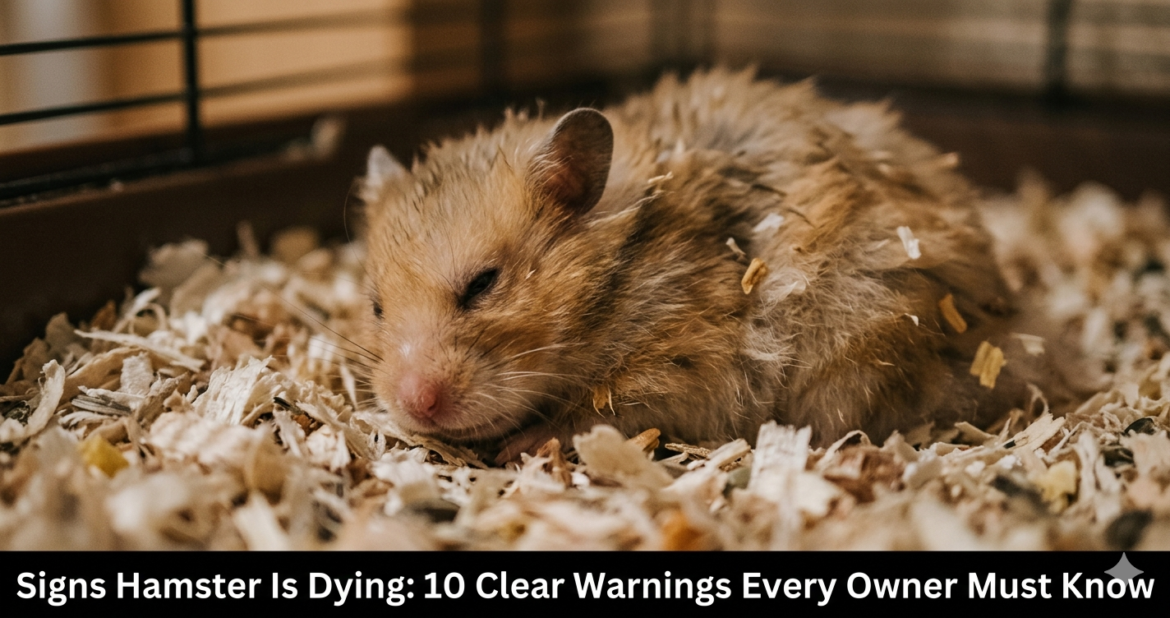
If you’ve noticed changes in your hamster’s behavior and you’re searching for signs your hamster is dying, you’re in the right place. Hamsters hide illness until the very last moment — so knowing these warning signs could save your pet’s life.
This guide covers 10 real, vet-confirmed warning signs — from the earliest red flags to the unmistakable final symptoms. You’ll also learn how to tell if your hamster is dying versus just hibernating, and what you can do right now to help.
| ⚠️ EMERGENCY — Go to vet immediately if you see: • Hamster lying on side, cannot move • Gasping or struggling to breathe • Cold body + not responding to warmth after 30 minutes |
| 📌 Quick Facts • Hamster average lifespan: 2–3 years (Syrian), 1.5–2 years (Dwarf) • Hamsters hide illness until very late — act fast when you see changes • Some signs = treatable illness, NOT death sentence — a vet can help • Middle age’ for a hamster starts at just 12–18 months |
For complete hamster care guide read How to Take Care of a Hamster: Complete Beginner’s Guide 2026
Why It’s So Hard to Tell If Your Hamster Is Dying
Hamsters evolved as prey animals in the wild. Showing weakness = becoming someone’s meal. So they hide every sign of illness for as long as physically possible.
Dr. Kristin Valdes, an exotic vet, explains: hamsters mask sickness until they simply can’t anymore — which means by the time you see obvious dying hamster behavior, their condition may already be serious.
This is why you need to know the subtle early signs — not just the dramatic final ones.
10 Signs Your Hamster Is Dying (From Early to Late Stage)
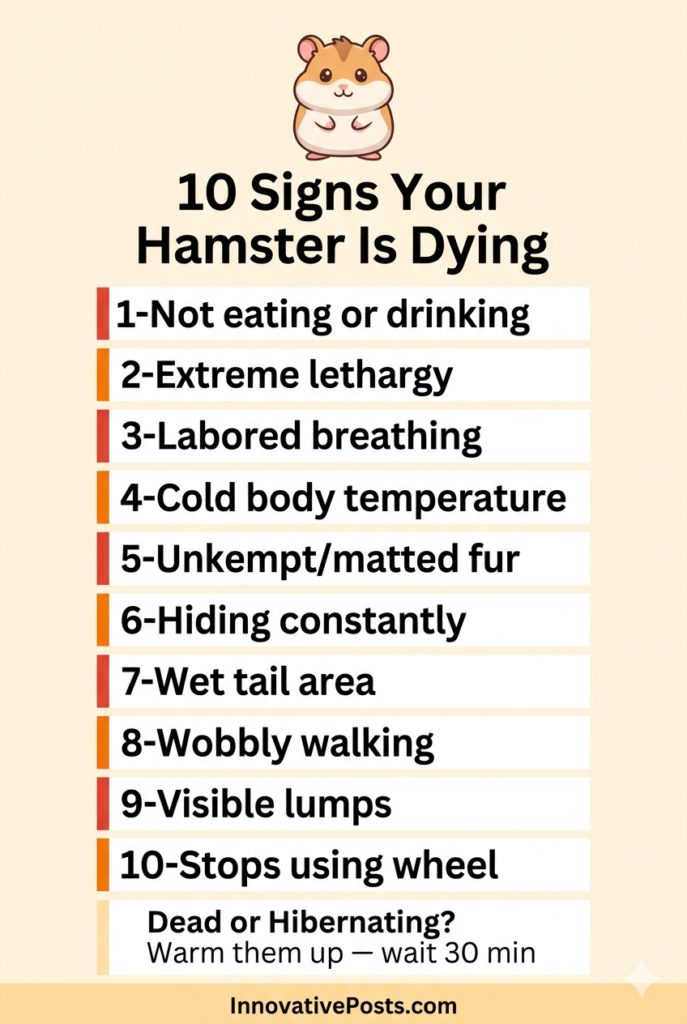
Sign #1 — Loss of Appetite and Refusing Favourite Treats
This is often the very first red flag. Your hamster normally goes crazy for sunflower seeds or vegetables — but now they sniff and walk away.
- Normal: occasionally skips a meal when stressed or adjusting to change
- Warning: consistently refuses food for 24+ hours
- Critical: not eating AND not drinking water
Rapid weight loss follows quickly. You may notice your hamster feels lighter when you pick them up, or looks visibly thinner around the hips.
Sign #2 — Extreme Lethargy (Not Just Normal Sleepiness)
This is the most misunderstood sign. Hamsters sleep a lot — up to 14 hours a day. So how do you know when it’s lethargy?
- Normal sleep: wakes up for food, responds when called, moves when gently touched
- Lethargy: stays curled up even when you offer treats, doesn’t respond to your voice, shallow breathing
If your hamster won’t wake up for their favourite snack, that’s a serious sign — not normal sleep.
Sign #3 — Labored or Noisy Breathing
This is one of the most urgent dying hamster signs. Normal hamster breathing is quiet and almost invisible.
- Watch for: visible chest movement, wheezing, squeaking sounds when breathing
- Noisy breathing = possible heart failure, respiratory infection, or fluid in lungs
- Labored breathing + lying on side = emergency — go to vet immediately
According to veterinary experts, a hamster struggling to breathe or lying on its side unable to move needs emergency care right away.
Sign #4 — Loss of Interest in the Exercise Wheel
Hamsters run 5–8 miles per night in the wild. A hamster that suddenly stops using their wheel is telling you something is very wrong.
This isn’t just boredom — a wheel-loving hamster that stops running is almost always experiencing pain, weakness, or serious illness. Combine this sign with any others on this list and contact your vet.
Sign #5 — Dull, Matted, or Unkempt Fur
Healthy hamsters groom themselves constantly. A sick hamster stops grooming because they simply don’t have the energy.
- Look for: fur that looks ruffled, greasy, or flat
- Check for: bald patches (possible mites or hormonal disease)
- Check for: wetness around the tail (wet tail — a deadly infection)
A hamster that looks dishevelled when they were previously neat is showing you they are using every bit of energy just to survive.
Sign #6 — Cold Body Temperature
A healthy hamster is warm to the touch. A dying hamster may feel unusually cold, especially in their paws and ears.
Important note: if your room temperature drops below 50°F (10°C), hamsters may attempt torpor — a hibernation-like state. Before assuming the worst, warm the room to 68°F (20°C) and wait 30 minutes. A hibernating hamster may slowly revive. A truly dying hamster will not.
| ❗ Is My Hamster Dead or Hibernating? The 3-Step Check; -Step 1: Gently place them in a warm room (68–72°F / 20–22°C) -Step 2: Very gently rub their back to encourage circulation -Step 3: Wait 30 minutes A hibernating hamster will slowly warm up and begin moving If there is NO response after 30 minutes in warmth — contact a vet. A deceased hamster will feel stiff (rigor mortis sets in within 1–2 hours). |
Sign #7 — Hiding Constantly and Avoiding Contact
Hamsters hide during the day — that’s normal. But a hamster that suddenly hides all the time, even at night, or refuses to come out for any reason, is showing distress.
In the wild, sick animals hide to avoid predators. This instinct kicks in when they are near the end. If your previously social hamster now wants nothing to do with you, don’t take it personally — it’s one of the clearest dying hamster behaviors.
Sign #8 — Diarrhea, Wetness Around the Tail, or Unusual Droppings
Wet tail (proliferative ileitis) is one of the most fatal hamster illnesses and progresses rapidly — a hamster can die within 24–48 hours if untreated.
- Signs of wet tail: wet, matted fur around the tail and bottom
- Signs of serious illness: diarrhea lasting more than 24 hours
- Signs of dehydration: skin ‘tents’ when gently pinched and doesn’t return quickly
Diarrhea can dehydrate and kill a small hamster very quickly. If you see this, contact your vet the same day.
Know the Signs of a Sick Hamster
Sign #9 — Seizures, Wobbly Walking, or Loss of Coordination
If your hamster suddenly stumbles, falls over, or has a seizure (jerking movements they can’t control), this is a neurological emergency.
- Possible causes: stroke, ear infection, brain tumor
- Hamsters with head tilt (always leaning to one side) may have an inner ear infection — treatable with antibiotics
- Seizures with no head tilt = potentially more serious neurological event
Any sudden loss of coordination in a hamster needs same-day veterinary attention.
Sign #10 — Visible Lumps, Tumors, or Swelling
Older hamsters (12+ months) are significantly more prone to tumors. You may notice:
- A hard or soft lump under the skin
- Swelling in the abdomen (could be organ failure or internal tumor)
- A lump in the cheek pouch that won’t empty (abscess or growth)
Some tumors grow slowly and are benign. Others are aggressive. A vet can tell you the difference and whether treatment is possible. Don’t wait — early detection matters even in hamsters.
Early vs Late Stage Signs — Quick Reference Table
| Sign | Early Stage | Late Stage / Emergency |
| Loss of appetite | Skipping some meals | Refusing all food + water |
| Lethargy | Less active, slower | Won’t respond to touch or treats |
| Breathing | Slightly faster breath | Visible labored breathing, wheezing |
| Temperature | Slightly cool paws | Cold body, unresponsive |
| Grooming | Occasional messy fur | Completely matted, wet tail area |
| Movement | Less wheel use | Cannot walk, wobbly, seizures |
What to Do When You See These Signs
Step 1 — Don’t Panic, But Don’t Wait
The moment you notice 2 or more signs from this list, act the same day. Hamsters deteriorate quickly. Waiting ‘to see if it gets better’ often means it’s too late.
Step 2 — Make Them Comfortable Right Now
- Warm the cage to 68–72°F (20–22°C) — no drafts
- Move food and water within easy reach — they shouldn’t have to travel
- Offer soft foods: mashed banana, plain cooked chicken, baby food (no salt/sugar)
- Reduce handling — stress makes things worse
- Keep the cage in a quiet, calm location away from noise and other pets
Step 3 — Contact a Vet
Find an exotic vet or small animal specialist — not all vets treat hamsters. Call ahead and describe the symptoms. Many serious conditions (wet tail, respiratory infections, ear infections) are treatable if caught early enough.
Step 4 — If Your Hamster Has Passed Away
- Allow yourself to grieve — this is a real loss
- Wrap your hamster in a soft cloth or tissue
- Do not flush — bury in the garden or check local pet cremation services
- Disinfect the cage thoroughly before introducing a new pet
Do Signs of Dying Differ by Hamster Breed?
The signs are similar across breeds, but there are some key differences:
- Syrian hamsters (2–3 year lifespan) tend to show signs more gradually as they age
- Dwarf hamsters (Roborovski, Campbell, Winter White) have shorter lifespans (1.5–2 years) and can decline faster
- All breeds are prone to wet tail, respiratory issues, and tumors — but dwarfs are especially prone to diabetes
Hamster Hibernation vs Dying — How to Tell the Difference
This is one of the most searched questions by hamster owners — and the confusion is completely understandable. Here’s the definitive answer:
| Hibernating Hamster | Dying Hamster |
| Body is cool but flexible | Body is cool and stiff (rigor mortis) |
| Responds slowly to warmth in 30–60 min | No response to warmth after 30+ minutes |
| Whiskers or nose may twitch slightly | No movement whatsoever |
| Room temp was below 50°F (10°C) | Normal room temperature |
| Gradual revival if warmed gently | Does not revive |
Frequently Asked Questions (FAQ)
How long does it take for a hamster to die after showing signs?
It depends on the cause. Some conditions like wet tail can be fatal within 24–48 hours without treatment. Others, like old age decline, may unfold over weeks. This is why you should never ‘wait and see’ — contact a vet the day you notice concerning signs.
Can a dying hamster recover?
Yes — sometimes. If the cause is a treatable illness (wet tail, respiratory infection, ear infection, dehydration), prompt veterinary care can save your hamster. If it is true old age decline or advanced organ failure, recovery is unlikely — but a vet can help ensure your hamster is comfortable and pain-free.
My hamster is not eating but still moving around — is it dying?
Not necessarily. Appetite loss can be caused by stress, a new food, or a minor stomach upset. Monitor for 24 hours. If they still won’t eat after 24 hours — especially if they’re also refusing water — contact your vet. Dehydration in a small hamster becomes dangerous very quickly.
What does a hamster look like just before it dies?
In the final hours, a hamster typically becomes very still, has labored or slow breathing, feels cold to the touch, and may lie on its side. They are usually unresponsive to handling. Their eyes may be partially closed. This is when keeping them warm, quiet, and comfortable matters most.
Is my hamster dead or just sleeping very deeply?
Gently touch their back. A sleeping hamster will react — even slightly — to your touch. A deceased hamster will be completely unresponsive and their body will begin to feel stiff within 1–2 hours of death. If you are unsure, warm the room to 70°F (21°C) and wait 30 minutes — this rules out torpor/hibernation.
How do I comfort a dying hamster?
Keep them warm (68–72°F), quiet, and close to their food and water. Minimize handling unless they seem to want comfort. Offer their favourite soft foods. Speak gently near the cage. The most important thing is that they feel safe, warm, and unstressed in their final time.
Should I take a dying hamster to the vet?
Yes — always. Even if recovery seems unlikely, a vet can determine the cause, rule out treatable conditions, and most importantly, provide pain relief. No hamster should suffer unnecessarily. Many owners are surprised to find that what they thought was a dying hamster was actually a very treatable illness.
Final Thoughts
Watching a hamster decline is genuinely heartbreaking — especially because their lifespans are so short to begin with. But knowing the signs of a dying hamster means you can act fast, get professional help when there’s still time, and ensure your little friend is comfortable and loved in their final days.
If you noticed even one or two of the signs above — don’t wait. Trust your instinct. You know your hamster better than anyone.
🔗 Related Articles: