Carrots are one of the safest and most nutritious treats you can give your hamster — but portion size and preparation matter. Find out exactly how much, how often, and how to serve them correctly.
Can hamsters eat carrots? If you have ever wondered whether this crunchy orange vegetable is safe for your little furry friend, the answer is a confident yes — and carrots are actually one of the best vegetable treats you can offer your hamster. Unlike sugary fruits, carrots are low in calories, packed with essential vitamins, and provide a dental workout that keeps your hamster’s ever-growing teeth healthy. If you are new to hamster ownership, we strongly recommend starting with our Complete Hamster Care Guide for Beginners to understand your pet’s full nutritional needs before introducing any new food. In this 2026 guide, you will learn everything about hamsters eating carrots — the benefits, the risks, breed-specific portions, raw vs cooked comparisons, and expert feeding tips.
Can hamsters eat carrots? Yes — One of the Safest Treats!
Carrots are completely safe and non-toxic for all hamster breeds. They are low in sugar (only 4.7g per 100g — much less than bananas or strawberries), high in Vitamin A, and their crunchy texture naturally helps wear down hamster teeth. Syrian hamsters can have a teaspoon-sized piece every other day. Dwarf breeds should get smaller portions 2–3 times per week. Always serve raw, washed, and cut into small pieces.
Can hamsters eat carrots every day? How much is too much? Are carrot tops safe? Is raw better than cooked? These are the questions every caring hamster owner asks — and in this guide, we answer every single one with vet-backed, up-to-date information for 2026.
Carrots have been a staple treat in small animal care for decades. According to RSPCA’s hamster diet guidelines, fresh vegetables like carrots make an excellent addition to a hamster’s diet when offered in appropriate amounts alongside their regular pellet food. Let’s dive into everything you need to know.
Nutritional Value of Carrots for Hamsters
Before we explore how hamsters can eat carrots safely, let’s look at exactly what carrots contain. Understanding the nutritional profile helps you make informed feeding decisions for your pet.
| Nutrient | Amount per 100g | Benefit for Hamster |
|---|---|---|
| Calories | 41 kcal | Low calorie — great for weight management |
| Natural Sugar | 4.7g | Low sugar — much safer than most fruits |
| Fiber | 2.8g | Supports healthy digestion |
| Vitamin A (Beta-carotene) | 16,706 IU | Eye health, immune support, skin & fur |
| Vitamin K | 13.2 mcg | Blood clotting and bone metabolism |
| Vitamin C | 5.9 mg | Immune system strengthening |
| Potassium | 320 mg | Heart health, reduces blood pressure risk |
| Calcium | 33 mg | Bone strength (moderate amounts only) |
| Magnesium | 12 mg | Nerve and muscle function |
| Water Content | 88% | Natural hydration support |
| Glycemic Index | 16 (Very Low) | Does not spike blood sugar rapidly |
Notice that carrots have a Glycemic Index (GI) of only 16 — any GI below 55 is considered low. This means carrots do not spike your hamster’s blood sugar rapidly, making them one of the safest treat options compared to high-sugar fruits. This is especially important for preventing diabetes-related hamster diseases, particularly in dwarf breeds.
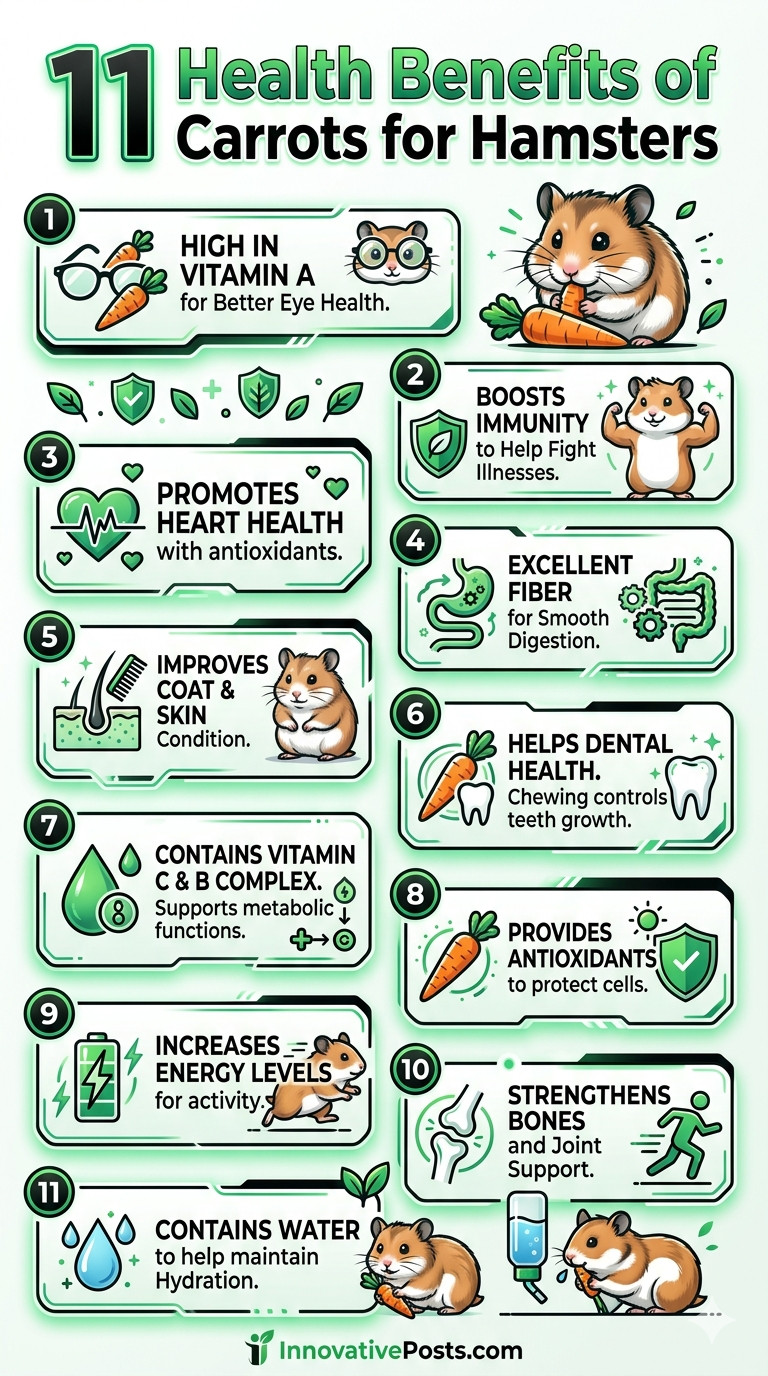
11 Health Benefits of Carrots for Hamsters
When you give carrots to your hamster in correct amounts, the health benefits are genuinely impressive. Here are 11 evidence-based reasons why carrots are one of the best treats you can offer:
Carrots stand out as one of the few treats that actually benefit hamster dental health directly. Since hamster teeth never stop growing, a hard crunchy treat like raw carrot provides the natural grinding action needed to prevent dangerous overgrowth. If you have noticed your hamster struggling with food, check our guide on why hamsters stop eating — dental problems are a common cause.
How Much Carrot Can Hamsters Eat? Breed-by-Breed Guide
Not all hamsters are the same — body size and diabetes susceptibility vary significantly by breed. Here is the complete serving size guide so you know exactly how much carrot your specific hamster can safely eat:
| Breed | Safe Serving Size | Frequency | Diabetes Risk | Status |
|---|---|---|---|---|
| 🐹 Syrian Hamster | 1 teaspoon (chopped) | Every other day | Low | SAFE |
| 🐹 Roborovski Hamster | ½ teaspoon (shredded) | 2–3x per week | Moderate | SAFE |
| 🐹 Winter White Hamster | ½ teaspoon (shredded) | 2–3x per week | High | CAUTION |
| 🐹 Campbell’s Dwarf | ¼ teaspoon (shredded) | 2x per week max | Very High | CAUTION |
| 🐹 Chinese Hamster | ¼ teaspoon (shredded) | 2x per week max | Very High | LIMIT |
For dwarf hamster breeds, always shred or grate the carrot rather than cutting it into chunks. Shredded carrot is easier to control in terms of portion size, reduces choking risk, and cannot be easily hoarded in cheek pouches where it could rot. Dwarf hamsters will happily eat even a few strands of shredded carrot as a treat.
You can also track your hamster’s weight monthly to make sure treats are not causing unwanted weight gain — use our Hamster Weight Chart by Breed and Age to monitor their healthy weight range.
Raw vs Cooked Carrots — Which Is Better for Hamsters?
This is one of the most common questions hamster owners ask. The short answer: raw carrots are always the better choice. Here is a side-by-side comparison:
- Full vitamin and mineral content preserved
- Crunchy texture aids dental health
- Higher fiber content supports digestion
- Natural sugars at lowest concentration
- No added substances from cooking
- Closest to natural foraging experience
- Softer texture — easier for elderly hamsters
- Loses 20–40% of vitamins during cooking
- Concentrated sugars after water evaporates
- No dental benefit — too soft to chew properly
- Risk of added salt/butter if human food
- Never serve with any seasonings or oil
The verdict: Always choose raw carrot for your hamster. The only exception is for very senior hamsters with worn or damaged teeth — in this case, a tiny piece of plain boiled carrot (no salt, no seasoning) can be offered occasionally. For more on caring for older hamsters, see our Hamster Life Stages: Baby to Senior guide.
How to Safely Feed Carrots to Your Hamster — Step by Step
Knowing that hamsters can eat carrots is just the start. Proper preparation is essential to make sure this healthy treat stays healthy. Follow these steps every time:
- Choose fresh, firm carrots. Select bright orange carrots without soft spots, mold, or excessive wrinkling. Fresh carrots have the best nutritional content and crunch factor.
- Wash thoroughly under running water. Scrub the surface to remove dirt, pesticide residue, and contaminants. Organic carrots are preferable but not essential if washed properly.
- Peel if using non-organic carrots. The skin of non-organic carrots may carry pesticide residue. Peeling is optional for organic carrots.
- Cut into appropriately sized pieces. Syrian hamsters: small cubes or sticks. Dwarf breeds: finely shredded or grated. Never give a whole carrot or large chunk — hamsters will try to stuff it into their cheek pouches.
- Serve raw at room temperature. Cold carrots straight from the refrigerator can cause digestive discomfort. Let it sit for a few minutes first.
- Offer by hand or in a clean dish. Hand feeding builds trust and lets you monitor how much they eat. Always use a ceramic or glass dish — not plastic.
- Monitor for the first 24–48 hours if it is their first time trying carrot. Watch for loose stools, diarrhea, or unusual lethargy.
- Remove uneaten pieces within 2 hours. Fresh carrot rots quickly and can cause bacterial growth in the cage. Check the bedding too — hamsters love to hoard food. Our Hamster Cage Cleaning Guide explains how to spot and remove hoarded fresh food safely.
Can Hamsters Eat Carrot Tops and Baby Carrots?
🌿 Carrot Tops (Carrot Leaves)
Yes — carrot tops are safe for hamsters and can be offered as an additional leafy green treat up to 2–3 times per week. Carrot tops contain many of the same nutrients as the carrot root but with far less sugar, making them an excellent option for dwarf hamster breeds that need to limit sugar intake. However, always wash carrot tops very thoroughly as supermarket carrot leaves are often sprayed with pesticides. Start with a very small piece and observe your hamster’s reaction before offering more.
🥕 Baby Carrots
Baby carrots from the supermarket are safe to feed, but with one important note: most commercially produced baby carrots are processed with a light chlorine rinse and have had their fiber-rich outer skin removed. This makes them slightly less nutritious than regular carrots. If using baby carrots, rinse them well and cut into small portions appropriate for your hamster’s breed size.
🚫 What to Avoid
- Carrot cake or any baked carrot products — contain sugar, butter, and additives
- Cooked carrots with salt, oil, or seasoning of any kind
- Carrot juice — concentrated sugar with no fiber benefit
- Overripe or soft carrots that have lost their crunch
- Very large carrot pieces that can get stuck in cheek pouches
- Frozen carrots — texture changes affect digestibility and dental benefit
Risks of Feeding Too Many Carrots to Hamsters
Carrots are far safer than most treats, but overfeeding still carries real risks. Here is what happens when hamsters eat too many carrots:
- Diarrhea and loose stools — the high water content (88%) can cause digestive upset if too much is given at once. Diarrhea in hamsters can escalate to wet tail disease if not addressed quickly
- Bladder stones — excess calcium from large carrot portions increases the risk of urinary stones over time
- Obesity and weight gain — even though carrots are low in calories, overfeeding any treat adds excess energy to a hamster’s diet
- Diabetes risk in dwarf breeds — Campbell’s, Winter White, and Chinese hamsters are genetically prone to diabetes and need strict carrot portion control
- Tooth decay — the natural sugars in carrots can contribute to dental problems if given too frequently without proper balance
- Nutritional imbalance — if carrots replace pellets as the main food source, hamsters will miss essential proteins and nutrients
- Spoiled hoarded food — hamsters stash food in their bedding; fresh carrot will rot quickly and can cause illness if eaten later
If your hamster shows signs of digestive distress after eating carrot — diarrhea, lethargy, bloating, or loss of appetite — remove all fresh food immediately and consult a vet. Learn the warning signs in our guide on Signs Your Hamster Is Dying to know when something requires urgent attention.
Carrots vs Other Hamster-Safe Vegetables — Comparison
How do carrots compare to other popular hamster vegetables? Here is a quick comparison to help you build a balanced treat rotation for your hamster:
| Vegetable | Sugar (per 100g) | Safe for Dwarfs? | Dental Benefit? | Frequency |
|---|---|---|---|---|
| 🥕 Carrot | 4.7g | ✓ Yes (small) | ✓ Excellent | Every other day |
| 🥒 Cucumber | 1.7g | ✓ Yes | ✗ Minimal | 2–3x per week |
| 🥦 Broccoli | 1.7g | ✓ Yes | ✗ Minimal | 2–3x per week |
| 🍓 Strawberry | 4.9g | ✓ Limited | ✗ None | Once a week |
| 🍌 Banana | 12g | ✗ Very Limited | ✗ None | Once a week max |
| 🥬 Spinach | 0.4g | ✓ Yes (occasional) | ✗ None | Once a week (high oxalates) |
Carrots consistently rank as one of the best all-round hamster treats — moderate sugar, excellent vitamin profile, genuine dental benefit, and high acceptability across all breeds. For a full breakdown of all safe and unsafe foods, visit our complete Hamster Food & Feeding Guide.
Frequently Asked Questions
Final Verdict: Can Hamsters Eat Carrots?
Can hamsters eat carrots? Absolutely yes — and carrots are arguably one of the best treats you can give your hamster. With a low glycemic index of just 16, a powerful Vitamin A content, natural dental benefits from their crunchy texture, and excellent hydration support from 88% water content, carrots tick every box for a healthy hamster treat.
For Syrian hamsters, a teaspoon of raw chopped carrot every other day is perfectly safe. For dwarf breeds, keep portions smaller — ¼ to ½ teaspoon of shredded carrot, 2–3 times per week. Always serve raw, always wash thoroughly, and always remove uneaten pieces within 2 hours to prevent spoilage in the cage.
Remember that carrots — as wonderful as they are — should complement your hamster’s primary diet of high-quality pellets, not replace it. Treats should make up no more than 10% of your hamster’s total food intake. Pair carrot treats with fresh water access, a clean cage, and plenty of enrichment activities for a happy, healthy hamster life.
Written by Emily Carter | Updated: April 2026 | InnovativePosts.com