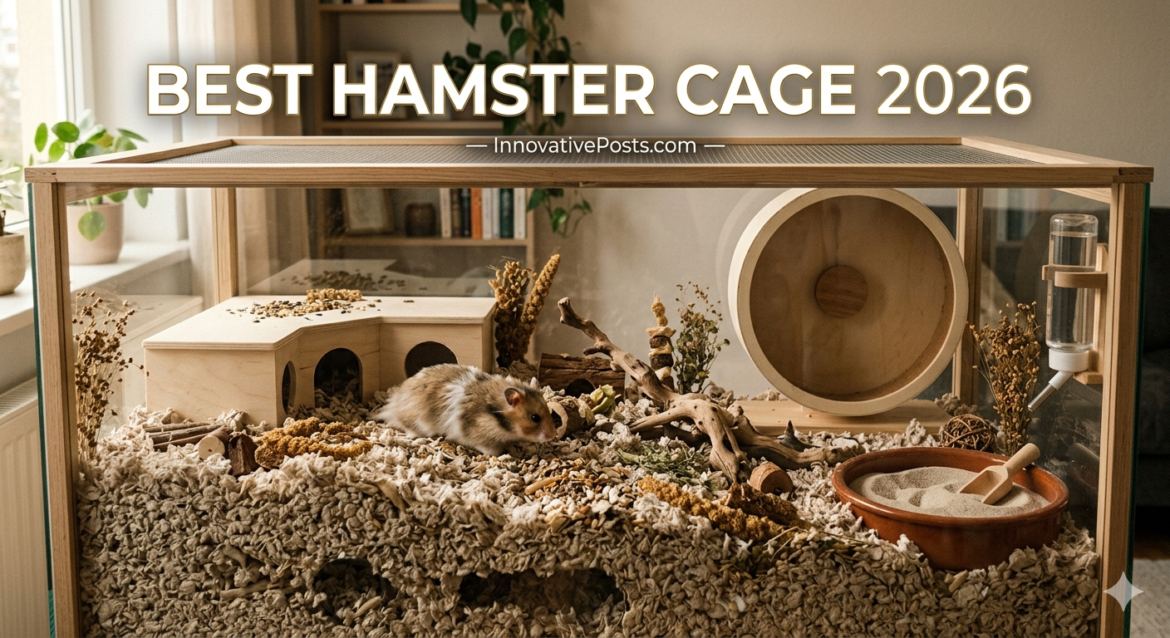
Let’s start with the one fact that changes everything about how you think about hamster cages.
📏 The Hard Truth About Cage Size in 2026
In the wild, Syrian hamsters run an average of 8–9 kilometres per night. They maintain territories spanning thousands of square metres, build multi-chamber burrow systems, and spend hours foraging across wide areas. The standard pet shop starter cage — typically 150–250 square inches — is roughly equivalent to keeping a human being in a cupboard.
This is not an exaggeration. A landmark study by the German Veterinary Association for Animal Welfare (TVT) tested hamsters in cages of four different sizes: 1,800cm², 2,500cm², 5,000cm², and 10,000cm². The results were unambiguous: stereotypic bar-chewing was significantly higher and more frequent in smaller cages, and hamsters in the smallest enclosures consistently showed higher stress indicators. Bar chewing — the most visible sign of cage-too-small stress — virtually disappeared in cages of 5,000cm² (775 square inches) and above.
- TVT (German Vet Association): Minimum 100×50cm / 775 sq inches for ALL hamster species
- RSPCA (UK): Recommends “as large as possible” — 100×50cm as a starting point
- Blue Cross, PDSA, Wood Green (UK): All recommend 100×50cm minimum
- California Hamster Association (US): 450–600+ sq inches minimum depending on species
- Most pet shop cages: 150–250 sq inches — 3–4× below minimum welfare standards
- Most “hamster starter kits” measure 150–250 sq inches — far below any welfare minimum
- Multi-level cages with tubes and platforms do NOT count toward floor space — only the unbroken ground level matters
- Height means very little for a ground-dwelling animal — width and length are what matter
- A cage sold as “suitable for Syrian hamsters” by a pet shop has no legal welfare requirement to meet in most countries
🐹 Minimum Cage Size by Hamster Breed
Different breeds have slightly different space requirements — but the key message is the same for all: bigger is always better, and the minimums below are floors, not targets.
🐹 Syrian Hamster
- Minimum floor space 775+ sq in
- Minimum footprint 100×50cm
- Ideal footprint 120×60cm+
- Bedding depth 6–10 inches
- Bar spacing (if barred) max ½ inch
🐹 Dwarf Hamsters
- Minimum floor space 775 sq in
- Minimum footprint 100×50cm
- Ideal footprint 100×60cm+
- Bedding depth 6–8 inches
- Bar spacing (if barred) max ¼ inch
🐹 Roborovski Dwarf
- Minimum floor space 775 sq in
- Minimum footprint 100×50cm
- Ideal footprint 100×50cm+
- Bedding depth 6 inches
- Bar spacing (if barred) max ¼ inch
🐹 Chinese Hamster
- Minimum floor space 775 sq in
- Minimum footprint 100×50cm
- Ideal footprint 100×50cm+
- Bedding depth 6 inches
- Bar spacing (if barred) max ¼ inch
The Syrian hamster requires the most space due to its larger body size and more extensive territorial instincts. However, the minimum footprint recommendation from welfare organisations is actually the same across all species — no hamster should be kept in anything smaller than 100×50cm regardless of breed. For breed-specific care details, see our Roborovski Hamster Guide.
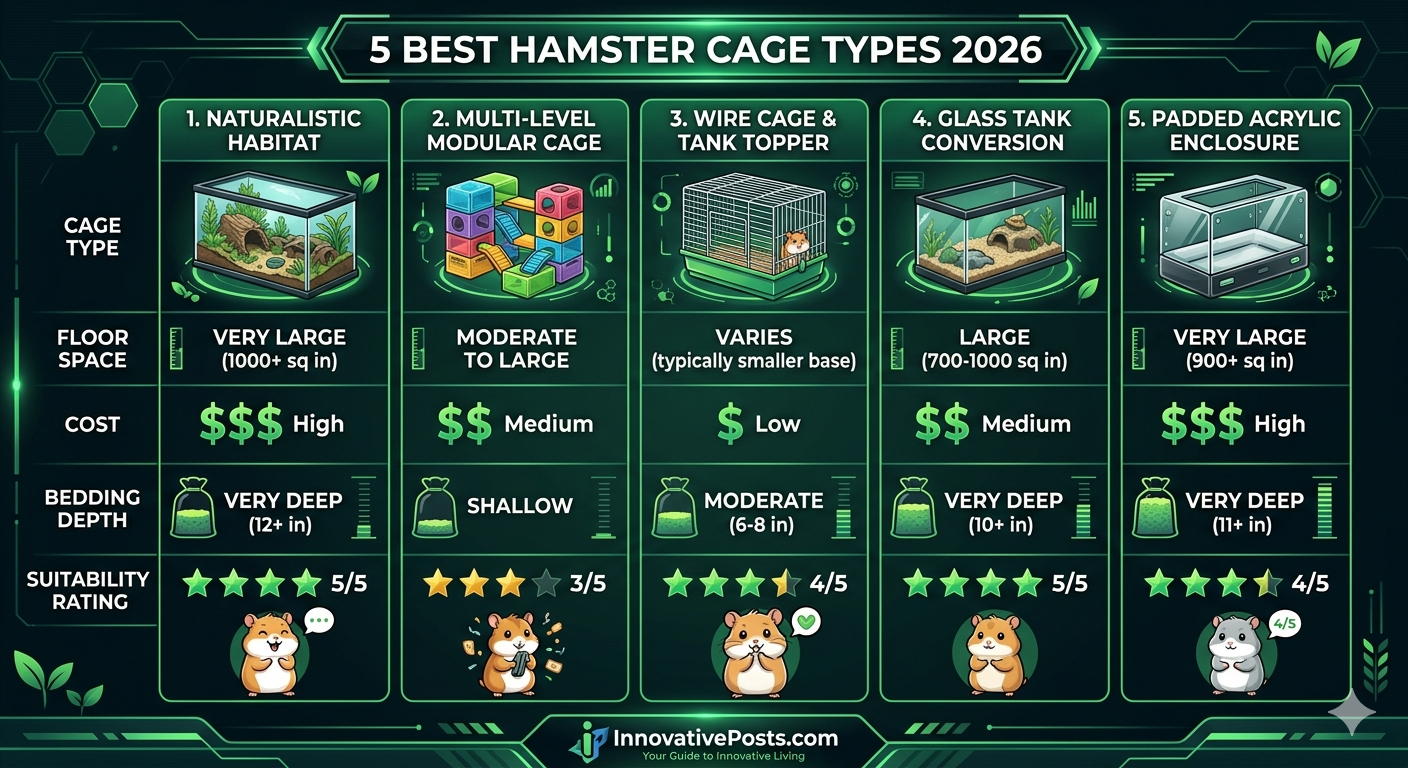
🏆 The 5 Best Hamster Cage Types Reviewed for 2026
There is no single “best” cage — the right choice depends on your budget, DIY ability, and which hamster breed you keep. Here is an honest, detailed review of every cage type available in 2026, in order from most recommended to least.
🗑️ DIY Bin Cage
⭐ Best Value 2026The DIY bin cage is the single most recommended hamster enclosure in the welfare community in 2026 — and it has been for several years. It consistently beats commercial cages costing five times as much in terms of floor space, bedding depth capacity, and overall hamster welfare outcomes.
A bin cage is made from a large clear plastic storage bin (minimum 40-gallon / 150-litre capacity) with a mesh ventilation panel cut into the lid. It costs $20–$40 in materials, provides 600–900+ square inches of unbroken floor space, accommodates 8–12 inches of deep bedding with no modifications, is lightweight and easy to move, and can be cleaned in minutes. The transparent sides give you an unobstructed view of your hamster’s activity — better than most barred cages.
The most popular bin cage base in 2026 is the IKEA SAMLA 130L (UK/Europe) or any large clear Sterilite/Rubbermaid container (US). For a Syrian hamster, aim for a bin that is at least 110cm long and 50cm wide at the base.
✅ Pros
- Largest floor space per dollar of any option
- Accommodates 8–12 inches of bedding easily
- Lightweight and easy to clean
- Completely escape-proof with mesh lid
- Clear sides for excellent viewing
- No bar spacing issues for small breeds
- Total cost: $20–$50
❌ Cons
- Requires 1–2 hours of DIY assembly
- Needs a drill, wire cutters, and zip ties
- Less aesthetically striking than premium cages
- Ventilation is only through top mesh lid
- Not ideal for very humid climates without side ventilation
- Step 1: Buy a large clear plastic storage bin (110L+ / 40+ gallon). Clear is important so you can observe your hamster
- Step 2: Draw a rectangle on the lid leaving a 5cm border around the edge. Cut out the centre with a craft knife
- Step 3: Cut a piece of hardware mesh (½ inch / 1.27cm squares) slightly larger than the hole. Drill small holes around the lid border every 7–8cm
- Step 4: Secure the mesh with zip ties through the drilled holes. Trim any sharp edges with electrical tape. Done — total build time: 60–90 minutes
🟫 Niteangel Bigger World / Vista Series
🏆 Best Commercial CageThe Niteangel series — particularly the Bigger World and Vista Medium/Large — are widely considered the gold standard of commercially available hamster enclosures in 2026. They combine an aesthetically beautiful wooden-and-acrylic design with genuinely welfare-appropriate dimensions, front-opening access doors, and a deep enough base to accommodate 6–8 inches of bedding.
The Niteangel Bigger World measures approximately 39.8″ × 23.7″ × 19.7″ (101×60×50cm), providing over 940 square inches of floor space — well above any welfare minimum. The Vista Medium offers around 820 square inches. Both are suitable for Syrian and dwarf hamsters. The front-opening door makes access easy and less startling for the hamster than top-access cages.
The primary downside is price: the Bigger World costs $200–$280 USD ($300–$400 AUD), making it a significant investment. However, for owners who want a premium-looking, welfare-appropriate enclosure without DIY work, it is the best ready-to-assemble option available in 2026.
✅ Pros
- 930+ sq inches floor space — welfare appropriate
- Beautiful wooden-acrylic aesthetic
- Front-opening door for easy access
- Deep base — fits 6–8 inch bedding depth
- Excellent compatible accessory range
- Good ventilation through mesh panels
❌ Cons
- Expensive: $200–$280 USD
- MDF/wood absorbs moisture over time
- Heavier and harder to move than bin cages
- Assembly required (2–3 hours)
- Wood can warp in very humid environments
🪟 IKEA Detolf (Hacked)
💡 Budget Glass OptionThe IKEA Detolf is a glass display cabinet that, when laid on its side with the glass door removed, creates a long, open enclosure with approximately 950–1,000 square inches of floor space — one of the largest glass enclosures available for under $100 USD ($69–$99 depending on location).
Converting a Detolf into a hamster cage requires no power tools — simply assemble the cabinet as per IKEA instructions, leave out the shelves and door, and add a DIY mesh lid for security. The glass sides provide crystal-clear viewing, no bar spacing concerns, and excellent humidity retention for burrowing stability.
One important caveat: the Detolf is quite narrow front-to-back (approximately 16 inches / 40cm). This makes it better suited to dwarf hamsters than Syrian hamsters, who benefit more from a wider footprint to build stable burrow chambers. For Syrians, the IKEA Linnmon hack (wider dimensions) is a better option despite requiring more DIY work.
✅ Pros
- 950+ sq inches for ~$69–$99
- Crystal-clear glass viewing
- Holds deep bedding beautifully
- No bar spacing — ideal for small dwarfs
- Easy to assemble — no power tools
- Sleek, modern aesthetic
❌ Cons
- Narrow footprint (40cm) — less ideal for Syrians
- Requires DIY mesh lid for security
- Heavy — not easy to move once set up
- Low height limits enrichment options
- Breakage risk if tipped
🐠 40–75 Gallon Glass Fish Tank
🐠 Classic OptionRepurposed fish tanks (aquariums) are a long-standing favourite in the hamster welfare community. A standard 40-gallon breeder tank (36″×18″×16″) provides 648 square inches of floor space at a relatively accessible price — often $60–$120 new, or much cheaper second-hand. A 75-gallon tank (48″×18″×21″) provides 864 square inches and is the ideal glass tank option for Syrian hamsters.
Glass tanks offer excellent bedding depth capacity, completely prevent bedding escape (unlike barred cages), provide clear viewing, and create a stable microclimate that helps burrowing. They require a secure mesh lid — purpose-built aquarium screen lids work perfectly. The main drawbacks are weight (a 40-gallon tank can weigh 60–80lbs when filled) and the difficulty of finding second-hand tanks in good condition.
Second-hand aquariums from Facebook Marketplace, Craigslist, or local selling groups are the most cost-effective large enclosure option available — a 75-gallon tank that retails for $150+ can often be found for $30–$60 second-hand.
✅ Pros
- Excellent bedding depth capacity
- No sand or bedding escape
- Crystal clear glass viewing
- Very cheap second-hand
- No bar spacing concerns
- Stable microclimate for burrowing
❌ Cons
- Very heavy — difficult to clean
- Requires separate screen lid purchase
- Top-access only — startles some hamsters
- Limited ventilation vs barred cages
- Breakage risk if moved frequently
🔲 Large Barred Commercial Cages
Barred commercial hamster cages — the type most commonly seen in pet shops — are the most problematic category in 2026. The vast majority sold in stores are far too small. However, a small number of genuinely welfare-appropriate barred cages do exist and are worth knowing about.
The Savic Plaza 120 (118×64cm / 756 sq inches) is the largest welfare-appropriate barred cage available in the UK in 2026, retailing for approximately £100 at Pets at Home. It has two access doors (top and front), 9mm bar spacing suitable for Syrians and dwarfs, and good ventilation. For bedding depth, perspex or grass mat panels can be added inside the bars to raise the effective floor level.
In the US, the Prevue Hendryx 528 and similar large rat cages with appropriate bar spacing (max ½ inch for Syrians) can work — but verify dimensions carefully before purchasing. Many “large” commercial cages still fall short of the 775 sq inch minimum once you account for the unbroken ground-level floor space requirement.
✅ Pros (Large Options Only)
- No DIY required — ready to use
- Excellent ventilation
- Easy bar-level observation
- Front and top access doors
- Wide accessory compatibility
❌ Cons
- Most sizes far too small for welfare
- Bedding escapes through bar gaps
- Limited depth for deep burrowing
- Small breeds can escape through bars
- Bar chewing still possible even in large versions
📊 All Cage Types Compared — Quick Reference
| Cage Type | Floor Space | Bedding Depth | Cost (USD) | DIY Needed | Best For |
|---|---|---|---|---|---|
| DIY Bin Cage | 600–900+ sq in | 8–12 inches ✅ | $20–$50 | 1–2 hrs | All breeds, all budgets |
| Niteangel Bigger World | 940 sq in | 6–8 inches ✅ | $200–$280 | Assembly only | Syrians & dwarfs, premium |
| IKEA Detolf (hacked) | 950–1,000 sq in | 8+ inches ✅ | $70–$100 | Mesh lid | Dwarfs, Roborovskis |
| 75-Gal Glass Tank | 864 sq in | 8–10 inches ✅ | $30–$150 | Screen lid only | Syrians & dwarfs |
| Savic Plaza 120 | 756 sq in | 4–5 inches ⚠️ | $100–$130 | None | Syrians (UK/Europe) |
| Most pet shop cages | 150–300 sq in | 1–2 inches ❌ | $30–$80 | None | Not suitable |
✅ 8 Non-Negotiable Features Every Hamster Cage Must Have
Regardless of which cage type you choose, these features are non-negotiable. A cage that checks size but fails on these points can still harm your hamster.
- Solid floor base — no wire flooring, ever. Wire causes bumblefoot (pododermatitis), a painful infection of the foot pads. Even partial wire flooring is harmful
- Correct bar spacing — maximum ½ inch (1.27cm) for Syrians; maximum ¼ inch (0.6cm) for dwarfs and Roborovskis. Too wide and hamsters escape; too narrow is fine
- Escape-proof design — latches that cannot be nudged open; no gaps at corners; secure mesh lid for open-top designs. Hamsters are remarkably persistent escape artists
- Adequate ventilation — at least one mesh wall or lid. Glass tanks and bin cages with solid lids cause ammonia and humidity buildup that damages respiratory health
- Enough height for enrichment — minimum 30cm (12 inches) internal height to accommodate a wheel, hideout, and enrichment without crowding
- Depth capacity for 6+ inches of bedding — the cage walls or sides must be high enough to contain 6–10 inches of substrate without constantly spilling over
- Easy cleaning access — a wide top opening or front door for regular spot cleaning without completely dismantling the setup
- No toxic materials — no painted wire, no zinc-coated mesh (zinc toxicity if chewed), no cedar or treated wood components in contact with bedding
🛋️ Essential Items Every Cage Needs Inside
A properly sized cage with nothing in it is still an inadequate cage. Here are the non-negotiable items every hamster enclosure must contain:
Silent Running Wheel
Solid surface, correct size (10–12″ Syrian, 8″ dwarfs). Not optional — see our Wheel Guide.
Enclosed Hideout
Dark, enclosed sleeping chamber. Ceramic or wooden. At least one per hamster — ideally two in different locations.
Sand Bath
Ceramic or glass container with dust-free reptile sand. Essential for coat health and mental stimulation. See our Sand Bath Guide.
Water Bottle or Bowl
Fresh water changed every 24 hours. Bottle preferred for cleanliness. Check nozzle daily for clogs.
Chew Items
Safe wood (apple, willow, hazel). Prevents overgrown teeth. Provides mental stimulation. Replace when depleted.
Tunnels
Cork tunnels or cardboard tubes. Satisfies above-ground burrowing instinct. Rotate weekly for novelty.
For a complete breakdown of enrichment beyond the basics, read our Hamster Enrichment Guide. A properly sized cage with good enrichment is directly linked to reduced hamster stress, better health, and a longer lifespan.
🔧 How to Set Up Your Hamster Cage: Step by Step
- 1Start with bedding first. Add at least 6 inches of paper-based or hemp bedding to the entire floor. Pack it down slightly at one end to help burrows hold their shape. Deep bedding is more important than any accessory you can add.
- 2Place the wheel in a permanent position. Pick one corner or wall position and keep it there permanently. Hamsters build a mental map of their space — moving the wheel repeatedly causes disorientation and stress.
- 3Add the hideout opposite or away from the wheel. The hide should be in a quieter, darker area of the cage — away from the main activity zone. Add a small pile of paper nesting material inside it.
- 4Place the sand bath in the hamster’s chosen toilet corner. If this is a new setup, choose one corner — most hamsters will naturally adopt the sand bath as their toilet within a few days. See our Sand Bath Guide for full toilet-training instructions.
- 5Scatter food through the bedding — do not use a bowl. Scatter feeding activates foraging instinct and is one of the single most impactful enrichment changes you can make. See our Feeding Guide for what to scatter.
- 6Add secondary enrichment items in the remaining space. Cork tunnels, a chew log, cardboard tube. Do not overcrowd — leave open floor space for burrowing and free movement.
- 7Introduce your hamster and leave them alone for 48–72 hours. Let your hamster map its new environment at its own pace. No handling, no rearranging. Place the cage in a quiet room away from other pets and loud appliances.
🚫 Cages to Avoid — Red Flags to Watch For
- Starter kits under 400 sq inches — marketed as “complete hamster homes” but dangerously undersized. The colourful packaging does not reflect welfare suitability
- Cages with tubes and connectors as the main space — tubes are not floor space. A hamster cannot burrow, forage, or run normally in a network of tunnels
- Wire flooring or partial wire bases — causes bumblefoot. Check the entire floor surface before purchase
- Tall, narrow cages designed for rats or ferrets — height is irrelevant for a ground-dwelling animal. A 200 sq inch footprint that is 3 feet tall is still dangerously small for a hamster
- Aquariums with only screen lids and no side ventilation under 40-gallons — too small and poor airflow causes ammonia buildup
- Any cage with bar spacing wider than ½ inch for Syrians — most adult Syrians can squeeze through ¾ inch gaps; dwarfs can escape through anything wider than ¼ inch
❓ Frequently Asked Questions (2026)
Final Thoughts: The Cage Is the Foundation of Everything
Every single aspect of your hamster’s health, behaviour, and lifespan connects back to the cage. The right cage — large enough, deep enough, properly furnished — prevents stress, prevents illness, prevents bar chewing, and gives your hamster the physical and mental space to live a genuinely fulfilled life.
The good news is that you do not need to spend a fortune. A $30 bin cage built in a single afternoon provides better welfare outcomes than a $100 pet shop “deluxe” starter kit. Start with floor space and bedding depth — get those right first, and everything else becomes much easier.
If your hamster is currently in an undersized cage, do not feel guilty — act. Most hamster owners discover the welfare standards too late. The most important thing is what you do once you know. Upgrade the housing, deepen the bedding, add enrichment, and watch your hamster transform.
Written by Emily Carter | Updated: April 2026 | InnovativePosts.com