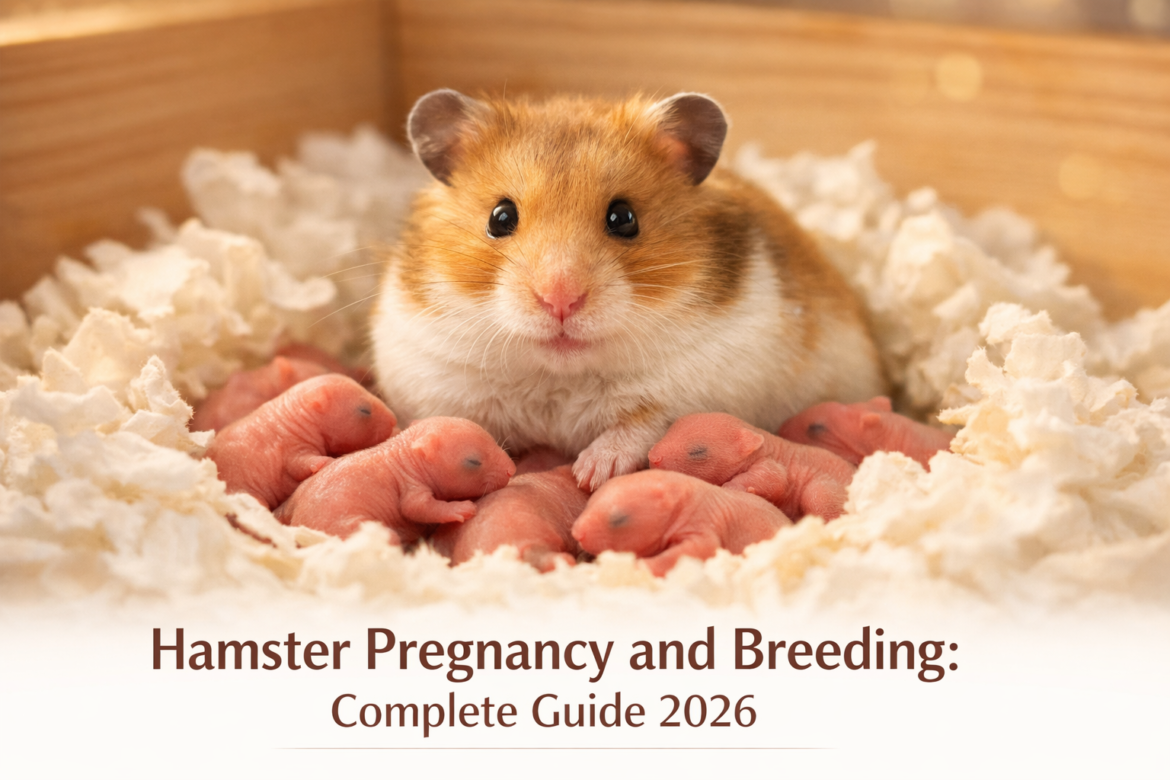
Hamsters are pregnant for just 16 days (Syrians) to 22 days (Dwarf breeds) — one of the fastest pregnancies in the pet world. This complete 2026 guide covers every stage: breeding age, pregnancy signs, birth, newborn pup care, and what to do (and never do) as a first-time breeder.
Thinking about breeding your hamster — or did you just realize your female might already be pregnant? Either way, you’ve come to the right place.
Hamster breeding is one of those topics that looks simple on the surface but hides a lot of nuance underneath. Get it right, and you’ll witness one of the most rewarding experiences in small pet ownership. Get it wrong, and things can go sideways fast.
This complete 2026 guide covers everything: when hamsters are ready to breed, how to spot pregnancy signs early, what happens during birth, and how to keep newborn pups alive and healthy.
Should You Breed Your Hamster? (Be Honest With Yourself First)
Before anything else — stop and think. Responsible breeding isn’t just about putting a male and female together and waiting. It’s a commitment that involves time, space, money, and a plan for rehoming babies.
Ask yourself:
Do you have separate cages ready for when the litter is weaned?
Do you have homes lined up for the babies?
Are you prepared for emergency vet visits?
If you’re not sure whether a hamster is even the right pet for you in the first place, read our full comparison: Hamster vs Guinea Pig: Which Pet Is Right for You? — it covers temperament, space needs, and commitment levels side by side.
Hamster Breeding Age: When Are They Ready?
The best time to breed hamsters is between 10 weeks and 15 months of age. But “can breed” and “should breed” are very different things.
Syrian hamsters: Ideal first breeding age is 4–6 months for females. They can technically conceive as early as 4 weeks, but this is dangerous — young mothers often abandon or cannibalize their pups.
Dwarf hamsters (Campbell’s, Winter White, Roborovski): Usually reach sexual maturity at 3–4 months when paired with a same-age mate.
Females younger than 13 weeks are likely to have complications in pregnancy and less healthy births. Females older than 8 months breeding for the first time may also have difficulties. The 4–6 month window is the sweet spot.
💡 Not sure which hamster breed you have? Understanding your hamster’s species makes a big difference in breeding timing and behavior. Check our complete hamster breeds guide for a full breakdown of Syrian, Dwarf, and Roborovski differences.
Understanding the Estrous (Heat) Cycle
Female hamsters have a precise 4-day heat cycle called estrous. Every fourth evening, she becomes receptive to mating for a window of 10–12 hours.
How to recognize when she’s in heat:
She becomes noticeably restless in the evening
She adopts a “lordosis” posture — stiffening her body, raising her tail, and widening her stance when you stroke her back
In Syrian hamsters, a thick white discharge appears on day 2 of the cycle
The Syrian estrous cycle day by day:
Day
What Happens
Day 1 (evening)
Sexually receptive — ready to mate
Day 2 (evening)
Receptive window closes; thick white discharge appears
Day 3
Discharge becomes waxy, then ends
Day 4
Dormant
Day 5
Cycle repeats from Day 1
Understanding this cycle is how you time introductions correctly and avoid dangerous mismatches.
How to Introduce Hamsters for Mating (Safely)
Never just put two hamsters in a cage together. Females can be seriously aggressive, especially outside of their heat window.
Step-by-step introduction:
Use neutral territory — bring the female to the male’s cage, or use a small box with fresh bedding. Never put the male into the female’s established cage.
Supervise every second — do not leave them alone.
Watch for lordosis — if she freezes and raises her tail, she’s receptive. This is a successful match.
Separate after 20–30 minutes — Syrian hamsters must be separated after mating. They are strictly solitary.
If fighting breaks out — separate immediately. Do not try again until her next heat cycle.
How Long Are Hamsters Pregnant? Gestation by Breed
Breed
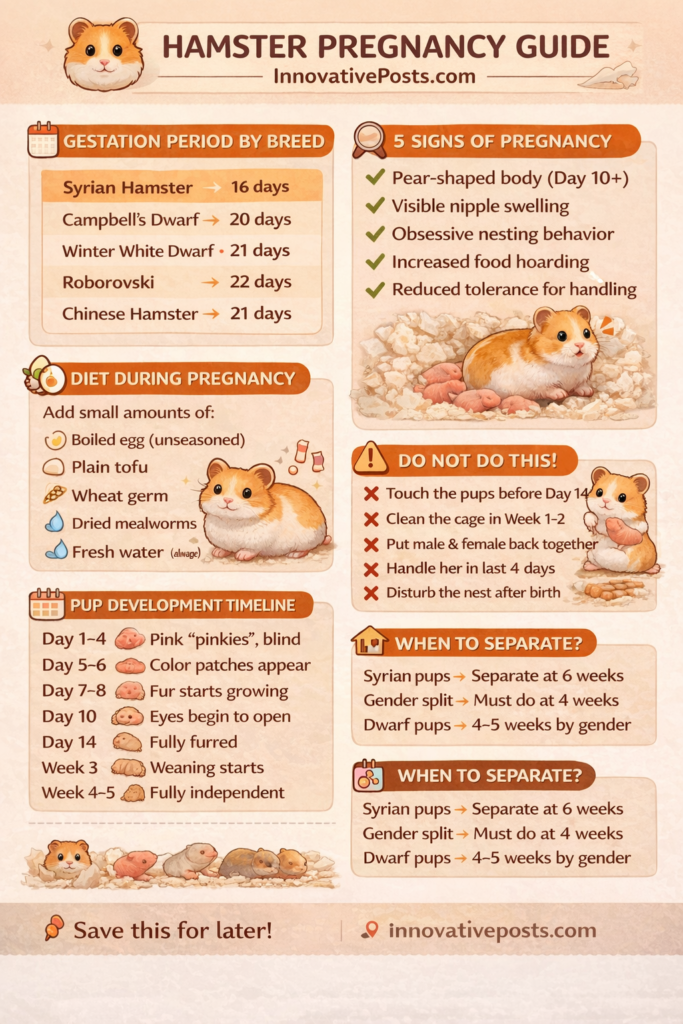
Gestation Period
Average Litter Size
Syrian Hamster
16 days
6–12 pups
Campbell’s Dwarf
20–22 days
3–5 pups
Winter White Dwarf
20–21 days
4–5 pups
Roborovski
20–22 days
3–6 pups
Chinese Hamster
21 days
3–5 pups
Syrian gestation is reliably 16 days — many sources say 16–18 but it’s almost always exactly 16. Campbell’s and Winter Whites can experience postimplantation diapause, where pregnancy is temporarily delayed after fertilization, which is why their timing can sometimes seem inconsistent.
Signs of Pregnancy in Hamsters
Physical signs (visible from Day 10 onward):
Pear-shaped, wider hips
A lumpy, rounded abdomen — bulges visibly rise above her body
Nipples swelling and becoming more prominent
Slight increase in overall girth
Behavioral signs (can appear within days of successful mating):
Obsessive nesting — gathering and rearranging bedding constantly
Aggressive food hoarding
Increased territorial behavior
Reduced tolerance for handling
⚠️ Many signs of pregnancy (nesting, hoarding) are also normal everyday hamster behaviors. Physical changes after Day 10 are the most reliable confirmation.
🔗 Want to understand what your hamster is telling you during pregnancy? Our hamster behavior and body language guide explains common postures and stress signals so you can tell the difference.
Caring for a Pregnant Hamster
Diet & Nutrition
A pregnant hamster needs a slightly higher protein diet — but don’t overdo it. Too much protein causes the pups to grow too large in the womb, making delivery difficult.
Safe high-protein additions:
Small piece of hard-boiled egg (unseasoned)
Tofu (plain, no additives)
Wheat germ
Mealworms (dried)
Keep fresh water available at all times — she’ll drink significantly more during pregnancy.
🥦 Knowing which foods are safe during pregnancy matters more than ever. Visit our hamster safe and unsafe foods guide for a complete list — including what to absolutely avoid.
Cage Preparation
Before the expected birth date:
Deep clean the cage one final time
Add at least 6 inches of paper bedding — more is better
Provide extra nesting material (plain paper towels or unscented tissue)
Remove the exercise wheel — a heavily pregnant hamster can get injured, and the wheel risks harming newborn pups
Move the cage to the quietest room in your home, away from other pets, loud noise, or foot traffic
Handling
From Day 12 onward, stop regular handling. The closer she is to giving birth, the more important it is to leave her completely alone. Stress during late pregnancy is one of the most common causes of pup abandonment.
The Birth: What to Expect
As labor approaches, she’ll become visibly restless and her nesting activity will intensify dramatically. Females usually give birth in the evening or early morning hours. Each pup arrives roughly 10–15 minutes apart, and the entire process typically takes around 2 hours.
During the birth — your most important rule:
Do not interfere. At all.
Cover the side of the cage where she has nested with a light cloth. Fill her food and water, and walk away. Do not open the cage, do not check on pups, do not touch anything inside.
If a pup appears outside the nest — do not touch it. Let the mother retrieve it. If she does not, hand-raising pups under 8 days old is extremely difficult and rarely successful.
When to call a vet immediately:
Labor lasts more than 4 hours with no pups delivered
You hear the mother screaming or screeching
There is an excessive or alarming amount of blood
These signs may indicate a pup is stuck and an emergency C-section may be needed.
Newborn Pup Development: Week by Week
Age
Development Milestone
Day 1–4
Hairless, eyes/ears sealed (“pinkies”)
Day 5–6
Patches of color visible on skin
Day 7–8
Fur emerging; begin eating solids from the nest
Day 10–12
Eyes beginning to open
Day 14–16
Fully furred; actively exploring the cage
Week 3
Weaning begins
Week 4–5
Fully independent
Do not touch the pups for the first 14 days minimum. A foreign scent on the pups is one of the primary reasons mothers cull their litters. Most experienced breeders recommend waiting until Day 18–21 for first handling.
Why Do Mother Hamsters Kill Their Babies?
This is one of the hardest realities of hamster breeding, but understanding it helps you prevent it.
Common reasons for pup culling:
Mother feels threatened or stressed by her environment
First-time mother who isn’t emotionally or physically mature
Foreign scent on the pups from human handling
A pup is weak, sick, or has physical problems
Nutritional deficiency — the mother may sacrifice the weakest pup to direct resources to the stronger ones
How to minimize the risk:
Never handle pups before 14 days
Keep the cage in a quiet, isolated space
Ensure she has adequate protein in her diet before and after birth
Do not clean the cage during the first 2 weeks
Keep cats, dogs, and other pets away from the room entirely
🔗 Post-birth stress behaviors are among the most misunderstood hamster signals. Our hamster behavior guide explains what to watch for and when behavior indicates a problem.
Separating the Litter: When and How
Syrian hamsters:
Separate by gender at 4 weeks to prevent early breeding between siblings
Remove all pups from the mother by 6 weeks completely
Each Syrian must be housed individually from this point forward
Dwarf hamsters:
Separate by gender at 4–5 weeks
Roborovski pups benefit from 1–2 extra weeks with the mother to learn natural hamster behaviors
The father dwarf hamster should be removed from the cage before birth — if left in, mating can occur within 3–4 days of delivery, producing a back-to-back litter while the first litter is still nursing.
Technically, females can breed multiple times — but overbreeding causes serious health problems.
Responsible breeding limits:
Maximum 2–3 litters per female in her lifetime
At least 2–3 months of rest between litters
Retire females from breeding by 12–14 months
Overbreeding leads to smaller, weaker litters and a significantly shortened lifespan for the mother.
Common Problems & Solutions
Problem
Likely Cause
Action
Female attacks male during intro
Not in heat
Wait 4 days, try again
No pregnancy after mating
Poor heat timing or stress
Re-introduce at next cycle
Mother abandoned pups
Stress, first-time mom, foreign scent
Cover cage — do not interfere
Small or weak litter
Young/old mother, poor nutrition
Improve diet before next breeding
Pup found outside nest
Displacement during birth
Do not touch — let mother retrieve
Mother lethargic after birth
Possible retained pup or infection
Vet visit immediately
Caring for Your Hamster After Breeding
Once pups are weaned and rehomed, your female needs real recovery time.
Continue protein supplementation for 2–3 weeks post-weaning
Do a full cage deep-clean after all pups leave
Reintroduce gentle handling gradually — she may be more defensive than usual
See a vet if she’s lethargic, not eating, or has any vaginal discharge
🏥 Post-breeding health issues are easy to miss if you don’t know what to look for. Our hamster health guide covers the most common post-birth complications and when to seek veterinary care.
FAQs related to Hamster Pregnancy and Breeding
1. How long are hamsters pregnant?
Syrian hamsters are pregnant for exactly 16 days — one of the shortest gestation periods of any mammal. Dwarf hamsters (Campbell’s, Winter White, Roborovski) are pregnant for 20–22 days. The gestation period begins from the first successful mating and ends at birth.
2. How do I know if my hamster is pregnant?
The most reliable signs appear around Day 10: a pear-shaped, wider body, swollen nipples, and visible lumps along the abdomen. Earlier signs include obsessive nesting, increased food hoarding, and restlessness. Behavioral signs alone aren’t reliable — wait for physical changes to confirm.
3. What should I feed my pregnant hamster?
A pregnant hamster needs a slightly higher protein diet. Add small amounts of plain boiled egg, tofu, wheat germ, or dried mealworms to her regular seed mix. Do not overfeed protein — too much causes pups to grow too large in the womb, making delivery dangerous.
4. Can I touch newborn hamster babies?
No. Do not touch newborn hamster pups for at least 14 days. A foreign smell on the pups can cause the mother to abandon or kill them. Most experienced breeders recommend waiting until Day 18–21 before any handling, when the pups are fully furred and the mother is settled.
5. Why did my hamster eat her babies?
Mother hamsters eat their babies (called culling) when they feel stressed or threatened, detect a foreign scent on the pups, are first-time or too-young mothers, or when a pup is weak or sick. It is a natural survival behavior — never interfere. Ensure a quiet, undisturbed environment to prevent it.
6. How many babies do hamsters have?
A typical hamster litter contains six to eight pups. Innovative Posts Syrian hamsters can have up to 12 pups per litter, while dwarf hamsters typically have 3–6. It has been known for hamsters to give birth to more than sixteen babies, so be prepared! Hamster Central
7. When can I separate baby hamsters from their mother?
Separate baby Syrians from their mother or siblings when they are 6 weeks old, and separate by gender as early as 4 weeks old Chewy to prevent inbreeding. Remove the first litter from the cage by the time they are 4 weeks old to avoid unplanned pregnancies. Philippinehamsterkeepers
8. How soon can a hamster get pregnant again after giving birth?
Female hamsters can become pregnant almost immediately after weaning their pups, typically within 24 to 48 hours. Hamster Clubhouse For Syrian hamsters this isn’t a concern as the male is separated after mating. For dwarf species, mating will likely occur as little as three to four days after birth Innovative Posts if the male remains in the cage — remove him immediately.
9. What age should hamsters be before breeding?
The ideal breeding age for female hamsters is 4–6 months. Mother hamsters younger than 13 weeks old are likely to have complications in pregnancy and less healthy births. Mother hamsters older than 8 months for their first litter may also have other kinds of pregnancy problems. Tumblr
10. How do I prepare a cage for a pregnant hamster?
Before the due date: deep-clean the cage, add 6+ inches of paper bedding, provide extra nesting material (plain tissue or paper towels), remove the exercise wheel, and move her to a quiet area. Wikipedia Stop handling her from Day 12 onward and limit cage interaction to topping up food and water only.
Final Thoughts
Hamster pregnancy and breeding rewards patience above everything else. The owners who interfere the least during the birth process — and prepare the most beforehand — have the best outcomes.
Whether this was a planned breeding or a surprise litter, you now have the complete roadmap. Give the mother the quiet space she needs, respect her instincts, and those tiny pups have every chance of thriving.
🐹 Brand new to hamster keeping and setting up for the first time? Our complete hamster care guide for beginners covers everything from the right cage size to daily feeding routines — the perfect starting point before bringing any hamster home.